
Top 10 Employee Management Software in India for 2026
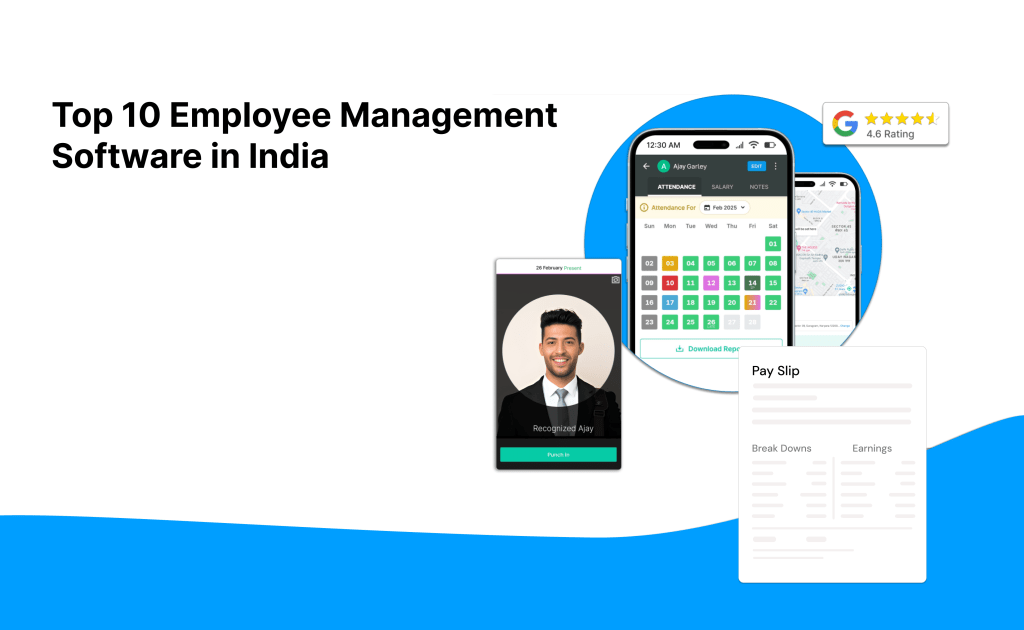
Employee management software is a cloud platform that automates staff attendance, payroll, leave tracking, and HR compliance in one place — replacing registers, Excel sheets, and disconnected WhatsApp groups. For Indian businesses in 2026, the best employee management software combines mobile-first attendance, automated PF/ESI/TDS compliance, and multi-location visibility at a price that scales per employee.
Here is the ranked shortlist for 2026:
- SalaryBox — Best overall for MSMEs, multi-location teams & field workforce
- Keka HR — Best for tech-first SMBs focused on performance management
- uKnowva HRMS — Best for Growing Businesses Seeking an All-in-One Employee Management Platform
- Zoho People — Best if you already use the Zoho ecosystem
- HROne — Best inbox-style HR experience for mid-market
- Darwinbox — Best enterprise-grade HCM for 1,000+ employees
- factoHR — Best for manufacturing, logistics & blue-collar teams
- Pocket HRMS — Best AI-chatbot-driven SMB option
- Qandle — Best modular HRMS where you pay only for what you use
- PagarBook — Best lightweight app for micro-businesses & daily-wage staff
| How we evaluated these tools We evaluated 28 employee management platforms against five criteria weighted for Indian SMEs: (1) India-specific statutory compliance (PF, ESI, PT, TDS, Form 16), (2) mobile-first attendance with GPS/selfie/biometric, (3) multi-location visibility, (4) pricing transparency per employee per month, and (5) publicly verifiable customer base. Data current as of April 2026. |
Employee Management Software Comparison Table
| Software | Best For | Starting Price | Mobile App | India Compliance |
| SalaryBox | MSMEs, Enterprise, multi-location & field | Per employee/month | Yes (Android & iOS) | PF, ESI, PT, TDS |
| Keka HR | Tech SMBs, performance mgmt | ₹6,999/mo (up to 100) | Yes | Full |
| uKnowva HRMS | Payroll compliance SMEs | Custom | Yes | Full |
| Zoho People | Zoho-ecosystem users | ₹48 per user/month | Yes | Full (with Zoho Payroll) |
| HROne | Mid-market HR automation | Custom | Yes | Full |
| Darwinbox | Large enterprises | Custom | Yes | Full + global |
| factoHR | Manufacturing & logistics | Custom | Yes | Full + Factories Act |
| Pocket HRMS | SMB with AI chatbot | Custom | Yes | Full |
| Qandle | Modular pay-per-module | Free forever tier | Yes | Full |
| PagarBook | Daily-wage & micro-biz | Freemium | Yes | Basic |
Why Indian Businesses Are Moving to Employee Management Software in 2026
If your HR team still chases WhatsApp voice notes for attendance, reconciles Excel sheets at the end of every month, and manually computes PF and ESI deductions, you are losing somewhere between 40 and 60 hours of productivity every single month. For a company with 50 employees, that is roughly ₹1.2–1.8 lakh in hidden HR cost — before we count the compliance penalties and payroll disputes that manual systems create.
This is exactly the problem modern employee management software solves. A good platform in 2026 brings staff attendance, payroll, leaves, compliance, and performance into a single system that your team can access from a mobile phone. The best ones go further — adding AI-powered selfie attendance, geofence controls for multi-site operations, automated statutory filings, and employee self-service that takes the approval workflow off your HR manager’s plate entirely.
The shift is accelerating: India’s HR software market is expected to cross USD 2.8 billion by 2028, and mobile-first platforms are growing 3x faster than desktop-based legacy tools. If you’re still evaluating whether your business needs employee management software, the better question is: what will it cost you not to have one? For a broader view of workforce management specifically, read our detailed breakdown of the best workforce management software in 2026.
What to Look For in Employee Management Software (2026 Buyer’s Checklist)
Before we rank the top 10, use this checklist to filter out software that looks good in a demo but fails on the shop floor.
1. Mobile-first, not mobile-bolted-on
Your employees don’t sit at desktops. Retail staff, factory workers, sales executives, and delivery teams live on their phones. The software must have a full-featured Android and iOS app — not a shrunken version of a desktop dashboard.
2. India-specific statutory compliance
Provident Fund (PF), Employee State Insurance (ESI), Professional Tax (state-wise), TDS, and Form 16 generation must be automated. A global tool that ‘handles compliance’ rarely understands that Maharashtra PT is different from Karnataka PT, or that the Factories Act has its own overtime multiplier.
3. Multi-location visibility
If you run more than one branch, store, clinic, or site, the software should give you a single live view across all of them. Retail chains, multi-specialty clinics, and service businesses lose significant money because no one has real-time visibility into who is working where.
4. Attendance that feeds payroll automatically
This is the feature most legacy systems still get wrong. Attendance captured on a biometric machine or mobile app must flow directly into payroll — with overtime, LOP, and shift differentials calculated automatically. If your team still exports CSV files and reuploads them, you bought the wrong tool.
5. Pricing that scales per employee
Per-employee, per-month pricing is the fairest model for growing businesses. Flat-licence or tiered plans that penalise you for crossing a threshold (e.g., 51st employee) can double your bill overnight.
The Top 10 Employee Management Software in India for 2026
1. SalaryBox — Best Overall for MSMEs, Multi-Location Teams & Field Workforce
Best for: SMEs and enterprises with 10–2,000+ employees, multi-location operations, and deskless or field-based teams (retail, services, pathology labs, logistics, manufacturing).
SalaryBox is a mobile-first employee management platform built specifically for Indian businesses that need attendance, payroll, and HR in a single app. It is used by brands like Tata, TVS, Shoppers Stop, ICICI Lombard, Hitachi, Jindal, and Naturals — alongside thousands of SMEs across retail, pathology, education, and manufacturing. What sets it apart is depth on the deskless workforce: AI selfie attendance with anti-spoof detection, geofence control for multi-site teams, live location tracking for field employees, and automated PF, ESI, PT, and TDS compliance that handles state-wise variations out of the box. You can explore the full product suite on the SalaryBox operations page or the payroll module.
Pros
- AI selfie attendance + geofence + biometric device integration — works for office, shop, and factory setups.
- One-click online salary payments with automated PF, ESI, PT, and TDS compliance.
- Live multi-location dashboard — a live view of who is working, where, and when across all branches.
- Zero training needed: employees adopt it in minutes, not weeks.
Cons
- Advanced performance management is lighter than enterprise-only
- Best-suited for teams with smartphone access; pure-biometric setups work but some ESS features require the app.
Pricing: Per employee, per month — scales from small shops to multi-plant enterprises. See current plans on the SalaryBox pricing page.
2. Keka HR — Best for Tech-First SMBs Focused on Performance Management
Best for: Tech startups and product companies with 50–500 employees who want a modern UI and strong performance review workflows.
Keka has built a strong reputation in India’s tech SMB segment with its ’employee-first’ UI, OKR-style performance tools, and gamified attendance. It handles Indian payroll compliance well and integrates with most biometric devices. The interface is modern and requires almost no training for new joinees.
Pros
- Clean, modern UI — one of the lowest training curves in the category.
- Strong performance management with OKRs, continuous feedback, and 360-degree reviews.
- Pulse surveys and eNPS built in for engagement tracking.
Cons
- Pricing starts around ₹6,999/month for up to 100 employees — higher than per-employee tools for small teams.
- Factory-floor use cases (piece-rate wages, complex shift patterns) need workarounds.
3. uKnowva HRMS — Best for Growing Businesses Seeking an All-in-One Employee Management Platform
Best for: Mid-sized businesses and enterprises with 100–5,000+ employees that need a unified platform for HR, payroll, employee engagement, performance management, and workplace collaboration.
uKnowva HRMS is an all-in-one employee management software that helps organizations manage HR, payroll, attendance, leave, performance, and employee engagement from a single platform. Its highly customizable workflows, forms, and dashboards allow businesses to adapt the system to their unique processes, while AI-powered automation and seamless third-party integrations help streamline HR operations. The platform also offers a built-in digital workplace experience, enabling employees to access HR services, collaborate, and stay connected from one centralized hub.
Pros
- Comprehensive HRMS covering HR, payroll, attendance, leave, and performance management.
- Built-in employee engagement and social intranet features.
- Highly customizable workflows, forms, and approval processes.
Cons
- The extensive feature set may require a structured implementation process for organizations moving from spreadsheets or basic HR tools.
- Smaller businesses looking for only payroll or attendance management may not utilize the platform’s full capabilities.
4. Zoho People — Best if You Already Use the Zoho Ecosystem
Best for: Small and mid-size businesses already using Zoho Books, Zoho CRM, or Zoho Payroll.
Zoho People shines when you’re inside the Zoho ecosystem, especially when integrated with Zoho WorkDrive for seamless document management and collaboration. Native integration with Zoho Books, Zoho Payroll, and Zoho CRM eliminates duplicate data entry across finance, HR, and sales. At ₹48 per user per month starting, it’s one of the more affordable enterprise-grade HRMS options.
Pros
- Very strong customization — build your own modules without code.
- Seamless data flow across Zoho apps.
- Employee self-service is polished and app-friendly.
Cons
- Implementation can feel complex if you’re not already in the Zoho ecosystem.
- Indian payroll compliance requires bundling Zoho Payroll separately.
5. HROne — Best Inbox-Style HR Experience for Mid-Market
Best for: Mid-market HR teams (100–1,000 employees) managing high approval volumes.
HROne’s ‘Inbox-for-HR’ philosophy treats every HR task like an email to be cleared — approvals, onboarding, leave requests — reducing the mental load of juggling menus. It handles Indian payroll (PF, ESI, LWF) natively and includes asset management and an inbuilt help desk.
Pros
- Unique inbox-style workflow is genuinely faster for busy HR managers.
- Trusted by 2,000+ Indian companies.
- Strong attendance + GPS capabilities.
Cons
- Custom pricing — no transparent per-seat number.
- May feel like overkill for teams under 50 employees.
6. Darwinbox — Best Enterprise-Grade HCM for 1,000+ Employees
Best for: Large Indian and global enterprises with complex multi-entity, multi-geography HR needs.
Darwinbox achieved unicorn status in 2022 and raised an additional $180M in 2025. It serves 1,000+ enterprise customers representing more than 3 million employees across industries including financial services, manufacturing, retail, and hospitality. Features include voice-first HR, facial-recognition attendance, and advanced talent analytics.
Pros
- Highly scalable; handles complex multi-country, multi-currency payroll.
- Advanced analytics and AI-driven insights.
- Enterprise-grade security and compliance.
Cons
- Overkill — and expensive — for SMBs under 500 employees.
- Implementation can take 3–6 months for large rollouts.
7. factoHR — Best for Manufacturing, Logistics & Blue-Collar Teams
Best for: Factories, warehouses, logistics companies, and labour-intensive industries.
factoHR has developed specialized expertise for industrial sectors — production workers, machine operators, warehouse personnel, drivers — where attendance tracking must work on factory floors and outdoor sites. It supports biometric fingerprint scanners, facial recognition, RFID card readers, and mobile geofencing, plus Factories Act and Contract Labour Act compliance.
Pros
- Deep industrial compliance: Factories Act, Contract Labour Act, state-wise Shop & Establishment Acts.
- Supports 24/7 rotating shifts and piece-rate wage structures.
- Multiple attendance modalities — works in any plant environment.
Cons
- Interface is functional but less polished than Keka or HROne.
- Can feel complex for very small businesses.
8. Pocket HRMS — Best AI-Chatbot-Driven SMB Option
Best for: SMBs wanting conversational AI for employee self-service.
Pocket HRMS integrates an AI chatbot called ‘smHRty’ that lets employees check leave balances, shifts, and payslips through chat. It covers attendance, payroll, and compliance for Indian SMBs with a straightforward interface.
Pros
- AI chatbot reduces HR query volume significantly.
- Good mobile and biometric attendance tracking.
- Reasonable pricing for Indian SMB market.
Cons
- Heavy-industry workflows (complex overtime) need workarounds.
- Less known in enterprise segments.
9. Qandle — Best Modular HRMS Where You Pay Only for What You Use
Best for: Bootstrapped startups and small businesses that want to activate HR modules one at a time.
Qandle offers a modular design — you pay only for the features you use instead of a bloated all-in-one bundle. Founded by IIT/IIM graduates and now part of the MYND ecosystem, it supports 1,000+ companies with a Free Forever plan, Payroll OS at ₹999/month (up to 25 employees), and a Professional tier at ₹1,499/month.
Pros
- Pay only for the modules you use.
- Free Forever tier with unlimited employees for core features.
- Reimbursements processed 5x faster than many legacy systems.
Cons
- Feature set can feel thin until you activate multiple modules.
- Mobile app is less polished than top-tier competitors.
10. PagarBook — Best Lightweight App for Micro-Businesses & Daily-Wage Staff
Best for: Shop owners, construction contractors, and micro-businesses (under 25 employees) needing simple attendance + salary tracking.
PagarBook focuses on attendance and salary management for small businesses and daily-wage staff. Its mobile app lets managers record worker attendance with selfies or GPS, approve absences, and calculate wages including late fines and overtime. Employees can view attendance details and receive salary slips through the app.
Pros
- Very simple interface — perfect for non-tech-savvy owners.
- Mobile-first with selfie and GPS check-ins.
- Accessible pricing for very small businesses.
Cons
- Lacks advanced shift management or payroll automation.
- Statutory compliance features are basic vs SalaryBox or greytHR.
How to Choose the Right Employee Management Software for Your Business
Use this quick decision framework based on company profile:
For SMEs and multi-location businesses (10–500 employees)
Choose SalaryBox. The combination of mobile-first attendance, multi-site live visibility, and automated Indian compliance is unmatched at the per-employee price point. If you manage retail stores, clinics, service outlets, or field teams, this is the native fit. You can start a free trial in under 5 minutes.
For tech startups with a focus on culture and performance
Choose Salarybox for its performance management depth, or Zoho People if you’re already in the Zoho ecosystem.
For manufacturing, factories, and logistics
Choose SalaryBox or factoHR. Both handle Factories Act compliance, rotating shifts, and blue-collar attendance well. SalaryBox wins on mobile-first simplicity; factoHR wins when you need deep biometric hardware integrations.
For large enterprises (1,000+ employees)
Choose SalaryBox for complex multi-entity global workforces, or Darwinbox for Indian mid-market at scale.
For micro-businesses and shop owners
Start with SalaryBox’s entry plan. SalaryBox scales with you as you grow beyond 25 staff — migration isn’t needed later.
What’s Changing in Employee Management Software in 2026
Three shifts are reshaping the category this year:
1. AI agents replacing form-filling
Headcount planning, skill assessment, resume shortlisting, and policy-document generation are moving from manual HR tasks to AI agents. Platforms like SalaryBox are already shipping AI add-ons for each of these use cases.
2. MCP servers for connected HR data
Model Context Protocol (MCP) servers let HR platforms connect employee data across onboarding, performance, and helpdesk workflows. This is how HR becomes truly automated — an HR helpdesk that answers employee queries 24/7 by searching your internal policy documents, for example.
3. The death of desktop HRMS
By end of 2026, any HRMS that requires a desktop for core tasks (attendance, leave requests, payslip download) will be obsolete for the Indian SME market. Mobile-first is no longer a differentiator — it’s a baseline.
Frequently Asked Questions
What is employee management software?
Employee management software is a cloud or mobile platform that automates staff attendance, payroll, leave tracking, HR compliance, and employee self-service in a single system. It replaces manual registers, Excel sheets, and disconnected communication channels for HR tasks.
Which is the best employee management software for small business in India?
For most Indian small businesses (10–500 employees), SalaryBox is the best employee management software because it combines mobile-first attendance, automated PF/ESI/TDS compliance, and multi-location visibility at per-employee pricing. Keka HR is a strong alternative for tech-first teams, while greytHR suits compliance-heavy SMEs.
How much does employee management software cost in India?
Employee management software in India typically costs between ₹40 and ₹500 per employee per month, depending on feature depth and company size. Free plans exist for very small businesses (greytHR up to 25 employees, Qandle Free Forever tier, PagarBook basic). Enterprise solutions like Darwinbox and HROne use custom pricing.
Is employee management software different from HRMS?
Employee management software and HRMS (Human Resource Management System) overlap heavily. HRMS typically emphasizes the full employee lifecycle including recruitment, learning, and performance. Employee management software tends to focus on day-to-day operations — attendance, payroll, leaves, and compliance. In 2026, most Indian platforms offer both under a single brand.
Can employee management software handle PF, ESI, and TDS compliance?
Yes. Modern Indian employee management software like SalaryBox, greytHR, Keka, and factoHR automates PF, ESI, Professional Tax (state-wise), TDS calculations, and Form 16 generation. Global tools often require add-on modules or manual configuration for Indian statutory compliance.
Which employee management software works best for multi-location businesses?
SalaryBox is purpose-built for multi-location operations — retail chains, pathology labs, service businesses, and manufacturing units with multiple sites. Its live multi-site dashboard, geofence-controlled attendance, and centralized payroll across branches are core features, not add-ons.
Do I need biometric hardware for employee management software?
No. Mobile-first platforms like SalaryBox allow attendance via smartphone through AI selfie capture, GPS, and geofencing — no hardware required. Biometric devices are optional and useful for fixed-location workplaces. SalaryBox supports both smartphone and biometric-device attendance in the same account.
Related Reading on the SalaryBox Blog
- Best Workforce Management Software in 2026 — a companion post focused specifically on workforce scheduling and visibility.
- Leave Carry-Forward Policy: Best Practices and Tax Implications — essential reading for HR teams setting up leave rules in their new software.
- The HR Manager’s Guide to a Successful Performance Management Cycle — how to run effective reviews using your HR platform.
- What is HR? Full Form, Meaning, Roles, Types, and Salary Guide — a foundational explainer for HR beginners.
- Job Enlargement vs Job Enrichment: HR Design Strategies — for HR teams thinking about role design.
- Explore the full SalaryBox Blog for more HR, payroll, and compliance guides.
- Category: HR & Employee Management · Attendance Management · Payroll & Compensation
Final Word
The right employee management software in 2026 isn’t the one with the longest feature list — it’s the one your team actually uses on day 1 without training. For most Indian SMEs and multi-location businesses, that is SalaryBox. Try it free, compare it side-by-side with the options in this list, and pick what fits your workflow. The cost of staying on spreadsheets is higher than any software subscription you’ll ever pay.
