
10 Best Payroll Software in India for 2026 (Compliance, Pricing & Free Plans)
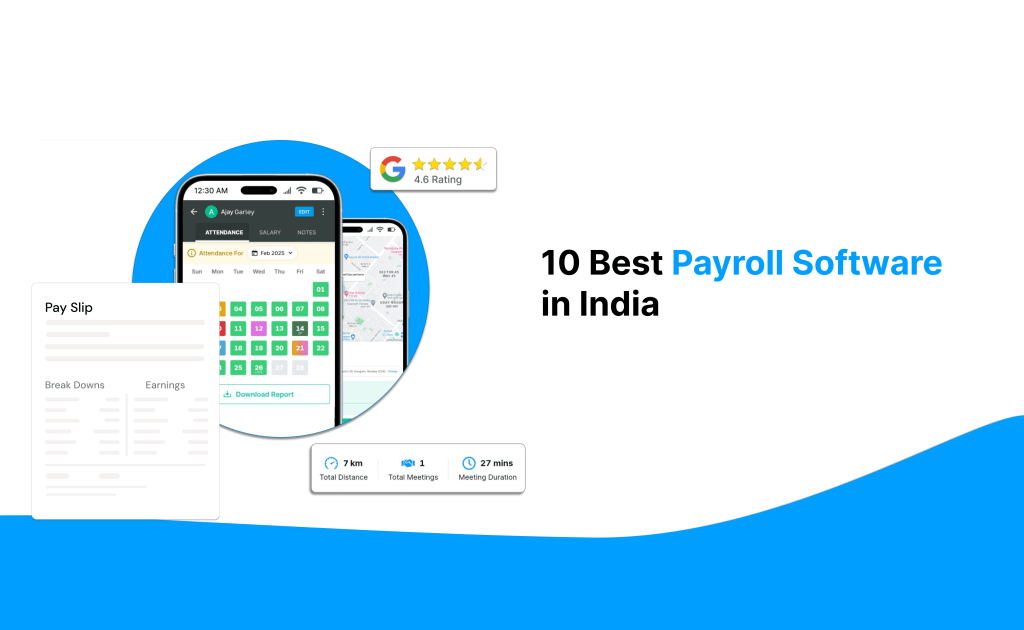
Quick Answer: The Best Payroll Software in India 2026
Payroll software is a cloud-based platform that automates salary calculation, statutory deductions (PF, ESI, Professional Tax, TDS), payslip generation, and bank-level salary disbursement for Indian businesses. The best payroll software for 2026 handles state-wise compliance automatically, integrates with attendance data, and scales from 10 employees to 10,000 without breaking.
Here is the ranked shortlist of the best payroll software in India for 2026:
- SalaryBox — Best overall for SMEs, multi-location & deskless workforce payroll
- greytHR — Best for pure payroll compliance with free plan up to 25 employees
- Zoho Payroll — Best for businesses already using the Zoho ecosystem
- RazorpayX Payroll — Best for startups wanting bank + payroll in one flow
- Keka Payroll — Best for tech SMBs with one-click payroll processing
- factoHR — Best for manufacturing & contract labour payroll
- Qandle Payroll — Best for pay-per-module modular payroll
- HROne Payroll — Best inbox-style payroll for mid-market HR teams
- Saral PayPack — Best traditional payroll tool for CA firms and accountants
- ADP India — Best for large enterprises with multi-country operations
| How we evaluated these tools We reviewed 24 payroll platforms across five criteria weighted for Indian businesses: (1) automated PF, ESI, PT, TDS compliance with state-wise accuracy, (2) attendance-to-payroll integration depth, (3) transparent per-employee pricing, (4) speed of salary disbursement, and (5) customer base and uptime. This list reflects current capabilities as of April 2026. |
Payroll Software Comparison Table
| Software | Best For | Starting Price | Free Plan | India Compliance |
| SalaryBox | SMEs, multi-location, field teams | Per employee/month | Free trial | Full (PF/ESI/PT/TDS) |
| greytHR | SME payroll compliance | Free up to 25 staff | Yes | Full |
| Zoho Payroll | Zoho ecosystem users | ₹60 per user/month | Free up to 10 | Full |
| RazorpayX Payroll | Startups needing bank + payroll | Free starter tier | Yes | Full |
| Keka Payroll | Tech SMBs | ₹6,999/mo (100 staff) | Free trial | Full |
| factoHR | Factory & contract labour | Custom | Free trial | Full + Factories Act |
| Qandle Payroll | Modular pay-per-use | ₹999/mo (25 staff) | Free Forever tier | Full |
| HROne Payroll | Mid-market HR | Custom | Free demo | Full |
| Saral PayPack | CA firms, accountants | One-time licence | No | Full |
| ADP India | Large enterprise | Custom | No | Full + global |
Why Indian Businesses Are Switching to Payroll Software in 2026
Picture this scenario. It’s the 28th of the month. Your HR executive is buried under attendance regularisation requests on WhatsApp. The finance team is still manually reconciling overtime from three different spreadsheets. Someone just realised the Maharashtra Professional Tax slabs changed two months ago and last month’s salary slips went out with the old rates. Your CA just called about a mismatch in the PF return.
If this sounds familiar, you are not alone. A recent industry survey found that Indian SMEs spend an average of 18 to 25 hours per month on manual payroll tasks, and nearly 43% of them have faced at least one statutory compliance penalty in the last two years. The good news is that modern payroll software in India has matured significantly. Today’s best payroll management software handles PF, ESI, Professional Tax, and TDS automatically, flows attendance data into salary calculations without manual intervention, and lets employees download payslips and Form 16 from their own phone.
What to Look For in Payroll Software in 2026
Before we rank the tools, here is the short checklist that separates a payroll system you’ll love in two years from one you’ll curse in six months.
1. Automated PF, ESI, PT, and TDS calculations
Your payroll software should handle state-wise Professional Tax (it’s different in Maharashtra, Karnataka, West Bengal, and Gujarat), monthly PF and ESI filings, and accurate TDS with Form 16 generation. If your finance team still computes these on a separate sheet, the software isn’t doing its job.
2. Attendance-to-payroll integration
Attendance data should flow directly into salary calculation. Late marks, half-days, leaves, overtime, and LOP must auto-adjust the final payout with zero manual copy-paste. This is the single biggest time-saver in the category.
3. One-click salary disbursement
Look for bank integration (ICICI, HDFC, YES Bank, Axis, etc.) that lets you disburse all salaries with a single approval click. If your team still downloads CSV files and uploads them to a bank portal, you’re leaving hours on the table every month.
4. Employee self-service (ESS)
Employees should be able to download payslips, submit tax declarations, view their salary break-up, and access Form 16 from a mobile app. This alone reduces HR query volume by roughly 60% in most companies.
5. Transparent per-employee pricing
Avoid tools that charge flat licences that jump when you cross a threshold (like from 49 to 51 employees). Per-employee pricing scales predictably as you grow.
The Top 10 Payroll Software in India for 2026
1. SalaryBox — Best Overall Payroll Software for SMEs & Multi-Location Teams
Best for: Indian SMEs and enterprises with 10–2,000+ employees, multi-branch operations, and deskless or field-based workforce.
SalaryBox is a mobile-first payroll and HR platform built specifically for Indian business realities. It is trusted by Tata, TVS, Shoppers Stop, ICICI Lombard, Hitachi, Jindal, and Naturals — alongside thousands of SMEs across retail, pathology labs, manufacturing, and service businesses. What sets it apart is the native combination of attendance, payroll, and compliance in a single app your team actually uses on day one. Automated PF, ESI, Professional Tax, and TDS compliance handle state-wise rate variations without manual configuration. One-click online payments push salaries to employees, contractors, and freelancers in a single flow. Overtime calculation is automated based on your attendance rules. You can explore the full feature set on the SalaryBox payroll page or start a free trial in under five minutes.
Pros
- Automated statutory compliance for PF, ESI, PT, and TDS with state-specific accuracy.
- One-click online salary payments to bank accounts, UPI, or wallet.
- Native attendance integration — LOP, overtime, and late fines flow directly to payroll with no manual steps.
- Mobile-first employee self-service with payslip download, Form 16, and tax declarations.
- Handles employees, contractors, daily-wage workers, and interns in the same payroll run.
Cons
- Global multi-country payroll is lighter than ADP or Darwinbox if you operate outside India.
- Very advanced executive-level compensation modelling needs additional configuration.
Pricing: Transparent per-employee per-month pricing that scales from small shops to multi-plant enterprises. See current plans on the SalaryBox pricing page.
2. greytHR — Best Free Plan for SMEs With Under 25 Employees
Best for: Small Indian businesses that want mature payroll compliance without paying anything until they cross 25 employees.
greytHR has been serving Indian SMEs for over a decade and is widely trusted by CA firms and payroll agencies. It offers a free plan for up to 25 employees, 99.5% uptime, and instant salary disbursement via greytHR PayNow. Hundreds of pre-built compliance reports keep you audit-ready without chasing documents.
Pros
- Genuinely free plan for up to 25 employees — rare in this category.
- Deep statutory compliance with auto-updates for PF, ESI, and PT rate changes.
- Instant salary transfers through greytHR PayNow.
Cons
- Interface feels dated compared to modern competitors.
- Advanced analytics are paid add-ons.
3. Zoho Payroll — Best for Businesses Already in the Zoho Ecosystem
Best for: Small and mid-sized businesses already using Zoho Books, Zoho CRM, or Zoho People.
Zoho Payroll shines when your finance and HR data already lives in other Zoho apps. Native integration with Zoho Books, Zoho People, and ICICI, HSBC, and YES Bank means payroll, accounting, and salary disbursement happen in one seamless flow. It auto-generates Form 12BB, 24Q, TDS returns, and Form 16 with built-in e-signature, and adapts to ever-changing Indian tax laws without manual updates.
Pros
- Free plan for up to 10 employees makes it attractive for early-stage startups.
- Deep integration across Zoho Books, People, and Expense apps.
- Automated tax forms with e-signature built in.
Cons
- Full value requires using other Zoho apps — standalone use feels limited.
- Mobile app is less comprehensive than desktop.
4. RazorpayX Payroll — Best for Startups That Want Bank + Payroll in One Flow
Best for: Indian startups and growing businesses that want salary payments, payroll, and compliance handled by a single fintech stack.
RazorpayX Payroll is unusual because it’s backed by a fintech (Razorpay) rather than a pure HR software company. This gives it a genuine advantage on salary disbursement speed and bank workflows. It fully automates TDS, PF, PT, and ESIC payments and filings, supports 45+ integrations with HRMS and attendance tools, and offers a plug-and-play setup that most startups can complete in under an hour.
Pros
- Fastest salary disbursement experience in the category thanks to Razorpay’s banking rails.
- True end-to-end tax automation including TDS, PF, PT, and ESIC filing.
- Free starter tier is generous for bootstrapped startups.
Cons
- Best-suited for mobile-lite, desk-heavy teams; less optimised for deskless workforce.
- Enterprise features like multi-entity accounting need the higher tiers.
5. Keka Payroll — Best for Tech-First SMBs With Performance Focus
Best for: Tech startups and product companies with 50–500 employees who want modern UI and strong performance workflows alongside payroll.
Keka processes payroll with a one-click run feature that’s been praised by tech HR teams. It combines payroll with OKRs, continuous feedback, and pulse surveys so that HR, payroll, and performance sit in a single dashboard. Compliance handling is solid for Indian SMBs.
Pros
- Modern, clean UI — low training curve for new HR hires.
- One-click payroll processing with clear audit trails.
- Performance management tightly integrated with salary revisions.
Cons
- Pricing starts around ₹6,999 for up to 100 employees — higher than per-employee tools for small teams.
- Factory-floor payroll workflows (piece-rate, complex shift overtime) need customisation.
6. factoHR — Best Payroll for Manufacturing and Contract Labour
Best for: Factories, logistics companies, and businesses with significant contract workforce.
factoHR specialises in industrial payroll where challenges include Factories Act compliance, Contract Labour Act tracking, piece-rate wages, and 24/7 rotating shifts. It supports biometric devices, facial recognition, RFID, and mobile geofencing, plus state-specific Shop & Establishment Act variations. It’s a payroll tool built for plant environments, not cubicles.
Pros
- Deep coverage of Factories Act and Contract Labour Act compliance.
- Handles piece-rate wages and complex overtime multipliers out of the box.
- Strong biometric hardware integration for plant environments.
Cons
- Interface is functional rather than modern.
- Can feel complex for small pure-office teams.
7. Qandle Payroll — Best Modular Payroll With Free Forever Tier
Best for: Bootstrapped startups and small businesses that want to switch payroll modules on and off as they grow.
Qandle’s modular approach lets you activate only the payroll features you need instead of paying for a bloated bundle. Founded by IIT/IIM graduates and now part of MYND’s ecosystem, it supports 1,000+ companies with a Free Forever plan, Payroll OS at ₹999/month for up to 25 employees, and a Professional tier at ₹1,499/month.
Pros
- Free Forever plan with unlimited employees for core payroll features.
- Modular design means you don’t pay for unused features.
- Fast reimbursement processing compared to legacy tools.
Cons
- Feature set can feel thin until you activate multiple modules.
- Mobile experience is less refined than top competitors.
8. HROne Payroll — Best Inbox-Style Payroll for Mid-Market HR Teams
Best for: Mid-market HR teams (100–1,000 employees) processing high volumes of approvals and exceptions.
HROne treats every payroll action — approvals, onboarding, expense claims — as an inbox-style task. Its automated payroll is fully localised for Indian labour laws, handling PF, ESI, and LWF without manual intervention. Trusted by over 2,000 Indian companies, including teams looking for a cleaner day-to-day HR experience.
Pros
- Unique inbox workflow is genuinely faster for busy HR managers.
- Strong Indian labour law handling out of the box.
- Good attendance + GPS integration with payroll.
Cons
- Custom pricing — no published per-seat number makes comparison harder.
- Feature density can overwhelm teams under 50 employees.
9. Saral PayPack — Best Traditional Payroll Tool for CA Firms and Accountants
Best for: Chartered accountants and payroll service providers managing payroll for multiple Indian SME clients.
Saral PayPack is the veteran of Indian payroll software, well-loved by CAs who handle compliance for dozens of SME clients. It offers comprehensive PF, ESI, PT, and TDS handling with full Indian statutory reporting and is typically sold as a one-time licence rather than SaaS.
Pros
- Proven compliance depth across Indian states.
- One-time licence model appeals to some accounting firms.
- Extensive report library for audit and regulatory submissions.
Cons
- Desktop-first; mobile and cloud features are limited.
- Modern UX and ESS features lag behind cloud-native tools.
10. ADP India — Best for Large Enterprises With Multi-Country Payroll
Best for: Large Indian enterprises with 1,000+ employees or multi-country operations.
ADP is a global payroll giant that has adapted well to Indian compliance. Scalable pricing, global tax handling, and deep integration with HR systems make it a common choice for Indian MNCs. It keeps pace with the latest Indian rules while providing cross-country payroll for global hiring.
Pros
- Global scale — ideal for businesses with teams across multiple countries.
- Strong security and compliance audit trails.
- Dedicated implementation and support for large rollouts.
Cons
- Custom pricing is steep for SMEs.
- Implementation can take 3–6 months for complex setups.
How to Choose the Right Payroll Software for Your Business
Here is a quick decision framework based on real company profiles I’ve seen at SalaryBox.
For SMEs and multi-location businesses (10–500 employees)
Choose SalaryBox. The combination of mobile-first attendance, multi-site live visibility, and automated Indian compliance is unmatched at this price point. Retail chains, clinics, and service businesses get the strongest ROI here.
For startups under 25 employees on tight budgets
Start with SalaryBox’s free plan or Zoho Payroll’s free tier. Both cover compliance basics well enough for early-stage teams.
For tech-first teams with strong performance culture
Choose SalaryBox Payroll for its performance-integrated payroll, or RazorpayX Payroll if salary disbursement speed matters more than HR depth.
For manufacturing, factories, and contract-labour-heavy businesses
SalaryBox wins on mobile-first simplicity and when you need deep biometric hardware integration for a fixed plant setup.
What’s Changing in Indian Payroll Software in 2026
Three shifts are worth paying attention to this year.
1. Real-time compliance updates
State PT slabs, ESI wage ceilings, and PF contribution rules change more often than most HR teams realise. Modern payroll software now pushes these updates automatically, so your next payroll run uses the new rates without anyone filing a ticket.
2. AI-powered payroll audits
AI agents inside payroll platforms now flag anomalies (unusually high overtime, unusual LOP patterns, duplicate entries) before payroll is processed — saving the embarrassment of salary reversals later.
3. Unified contractor and employee payroll
Indian businesses increasingly have a blended workforce of full-time employees, contractors, freelancers, and daily-wage staff. The best 2026 payroll tools process all four in the same flow, with correct TDS and statutory handling for each category.
| Ready to stop chasing compliance and payroll every month? SalaryBox replaces manual payroll registers, Excel overtime sheets, and last-minute CA calls with a single mobile-first platform trusted by Tata, TVS, Shoppers Stop, and thousands of Indian SMEs. Automated PF, ESI, PT, TDS. One-click salary payments. Real-time attendance integration. → Start your free trial · → See pricing · → Contact sales |
Frequently Asked Questions
What is payroll software?
Payroll software is a digital tool that automates salary calculation, statutory deductions (PF, ESI, Professional Tax, TDS), payslip generation, and bank disbursement. It replaces manual spreadsheets, ensures compliance with Indian labour laws, and reduces payroll processing time from days to minutes.
Which is the best payroll software for small business in India?
For most Indian small businesses with 10–500 employees, SalaryBox is the best payroll software because it combines automated PF/ESI/TDS compliance, mobile-first attendance integration, and one-click salary payments. greytHR offers a free plan for under 25 employees, and Zoho Payroll is ideal if you already use Zoho Books.
How much does payroll software cost in India?
Payroll software in India typically costs between ₹40 and ₹300 per employee per month.
Is free trial payroll software reliable for Indian businesses?
Yes, free trial plans from Salarybox, Zoho Payroll, and Qandle handle core payroll compliance for small teams. The limitations usually appear when you need advanced reports, custom workflows, or multi-location support — at which point you’ll want a paid plan from SalaryBox, Keka, or similar tools.
Can payroll software handle contractors and daily-wage staff?
Modern Indian payroll software like SalaryBox handles full-time employees, contractors, freelancers, and daily-wage workers in the same payroll run, with correct TDS and statutory handling for each category. Older tools sometimes require separate modules or spreadsheets for non-regular workforce.
How does payroll software handle PF, ESI, and TDS?
Good Indian payroll software automatically calculates Provident Fund (12%), Employee State Insurance (0.75% employee + 3.25% employer), Professional Tax (state-wise), and TDS based on each employee’s salary slab. It generates statutory challans, filings, and Form 16 without manual intervention.
How long does it take to implement payroll software?
Cloud-based payroll tools like SalaryBox, Zoho Payroll, and RazorpayX Payroll can be set up in under a day for small teams.
Related Reading on the SalaryBox Blog
- Top 10 Employee Management Software in India for 2026 — the pillar companion to this payroll guide.
- Best Workforce Management Software in 2026 — broader workforce tools beyond pure payroll.
- Leave Carry-Forward Policy: Best Practices and Tax Implications — essential context for setting up leave rules in your payroll software.
- The HR Manager’s Guide to a Successful Performance Management Cycle — how to link performance reviews to compensation.
- 7 Cheapest Payment Gateways in India for SaaS Startups in 2026 — useful context for startups comparing fintech-linked payroll.
- Browse more guides on the SalaryBox Blog or filter by Payroll & Compensation.
Final Word
The right payroll software in 2026 isn’t the one with the most features — it’s the one your team actually uses on day 31 without thinking. For most Indian SMEs and multi-location businesses, that is SalaryBox. Try it free, compare it against the options above, and pick what fits your workflow. A good payroll platform pays for itself inside 60 days through saved hours alone.
