
Top 9 HRMS Software for Small Business in India 2026 (Features, Pricing & Buyer’s Guide)
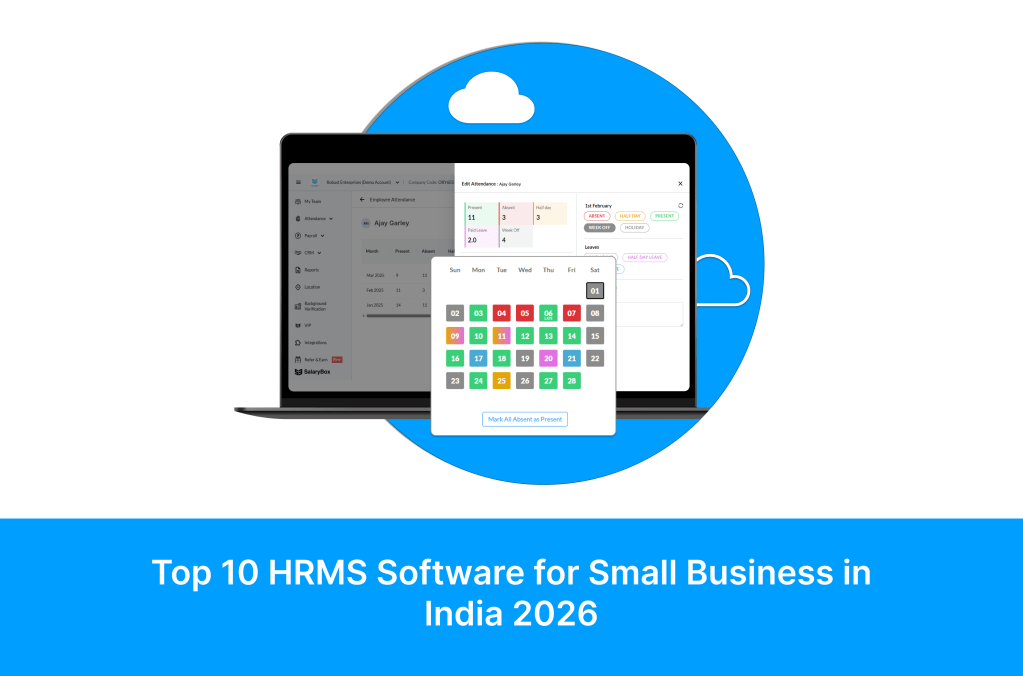
Quick Answer: Best HRMS Software for Small Business in India
HRMS software (Human Resource Management System) is a cloud platform that manages the full employee lifecycle in one place — from hiring and onboarding to attendance, payroll, leaves, performance, and exit. For Indian small businesses in 2026, the best HRMS software combines mobile-first attendance, automated statutory compliance (PF, ESI, PT, TDS), and pricing that scales per employee without nasty jumps at tier thresholds.
Here is the ranked shortlist for 2026:
- SalaryBox — Best overall HRMS for Indian SMEs, multi-location & field teams
- Keka HR — Best HRMS for tech-first SMBs and product startups
- greytHR — Best HRMS with a genuine free plan up to 25 employees
- Zoho People — Best HRMS for businesses already in the Zoho ecosystem
- HROne — Best inbox-style HRMS for growing mid-market SMBs
- Qandle — Best modular HRMS where you pay only for what you use
- BambooHR — Best HRMS for small manufacturing, logistics & blue-collar teams
- Pocket HRMS — Best AI-chatbot-led HRMS for SMB employee self-service
- DarwinBox— Best HRMS for distributed teams with bilingual support
| How we evaluated these tools We reviewed 30 HRMS platforms against five criteria for Indian small businesses: (1) Ease of setup and adoption, (2) India-specific statutory compliance, (3) Mobile-first design with full employee self-service, (4) Transparent and scalable pricing, and (5) A customer base that matches SME realities rather than enterprise ones. Rankings reflect April 2026 feature parity. |
HRMS Software Comparison for Small Business (India 2026)
| HRMS Software | Best For | Starting Price | Mobile App | Indian Compliance |
| SalaryBox | SMEs, multi-location, field | Per employee/month | Yes (full) | PF/ESI/PT/TDS |
| Keka HR | Tech SMBs | ₹6,999/mo (100) | Yes | Full |
| greytHR | Compliance SMBs | Free up to 25 | Yes | Full |
| Zoho People | Zoho users | ₹48/user/month | Yes | Full (with Zoho Payroll) |
| HROne | Mid-market SMBs | Custom | Yes | Full |
| Qandle | Modular SMBs | Free Forever tier | Yes | Full |
| BambooHR | Small manufacturing | Custom | Yes | Full + Factories Act |
| Pocket HRMS | AI-chat SMBs | Custom | Yes | Full |
| DarwinBox | Distributed SMBs | Custom | Yes | Full |
Why Indian Small Businesses Need Proper HRMS Software in 2026
Small businesses are the engine of the Indian economy, and they run on people. But most SMEs still manage HR through a patchwork of tools — Excel for attendance, a separate app for leaves, WhatsApp for approvals, a CA for payroll, and a filing cabinet for employee documents. This patchwork works when you have 10 people. It creaks when you reach 25. It breaks when you cross 50.
HRMS software solves this by bringing every HR workflow — onboarding, attendance, leaves, payroll, performance reviews, policy acknowledgments, exit interviews — into one system. In 2026, the best HRMS for Indian small businesses is mobile-first (because your team isn’t at a desktop), compliance-ready out of the box (because PF, ESI, and PT rules keep changing), and priced per employee so your bill grows predictably with your headcount.
What to Look For in an HRMS for Your Small Business
1. Actual mobile-first design (not a desktop app on a smaller screen)
Your team lives on their phones. The HRMS mobile app must support the full range of daily tasks — marking attendance, applying for leave, viewing payslips, acknowledging policies — not just the basics. If your HR team needs a laptop for routine tasks, you’ll lose the momentum every time they’re on the move.
2. India-ready compliance, not ‘compliance in most countries’
Provident Fund, Employee State Insurance, Professional Tax (state-wise), TDS, and Form 16 generation must be automated. If you need a separate Excel for statutory filings, the HRMS isn’t really HRMS — it’s just an employee database.
3. Quick implementation without consultants
A good SMB HRMS should be live in under a week without hiring a consultant. Enterprise tools often require 2–3 month implementations, which isn’t realistic for a 40-person company. Look for self-serve onboarding with clear setup wizards.
4. Employee self-service that employees actually use
The HR team can’t be the single point of truth for every leave application and payslip request. A good HRMS gives employees a mobile app where they can handle 80% of their own needs — apply for leaves, check balances, view payslips, submit reimbursements, update personal info.
5. Per-employee pricing with no sudden jumps
Avoid tier-based pricing that penalises you for crossing 50 or 100 employees. Per-employee, per-month pricing is predictable and scales smoothly.
6. Upgrade path as you grow
The HRMS you choose at 50 employees should scale to 500 without forcing migration. Migration pain is expensive — both in time and in change management. Choose a platform that has customers at your target size, not just your current size.
The Top 10 HRMS Software for Small Business in India 2026
1. SalaryBox — Best Overall HRMS for Indian SMEs & Multi-Location Teams
Best for: Indian small and mid-sized businesses with 10–2,000+ employees across retail, pathology labs, services, manufacturing, and field operations.
SalaryBox is the most widely adopted HRMS software for Indian SMEs that need real mobile-first HR. It’s trusted by Tata, TVS, Shoppers Stop, ICICI Lombard, Hitachi, Jindal, and Naturals, alongside thousands of small businesses. The platform covers the full HRMS scope — onboarding, attendance, leaves, payroll, compliance, document management, training, and employee self-service — in one app. The four-way attendance capture (AI selfie, GPS, geofence, biometric), automated PF/ESI/PT/TDS, one-click online salary payments, and live multi-location dashboard are all native features, not add-ons. AI add-ons for headcount planning, skill assessment, resume shortlisting, and document creation give you an advantage you won’t get from most competitors.
Pros
- End-to-end HRMS built for Indian realities — attendance, payroll, leaves, compliance, training, all in one app.
- Four attendance capture modes including AI selfie with anti-spoof detection.
- Automated PF, ESI, PT, TDS with state-wise variations handled out of the box.
- Zero training needed — new employees use it productively from day one.
- AI add-ons for headcount, skills, resume shortlisting, and HR helpdesk.
Cons
- Enterprise-level compensation modelling needs custom configuration.
- Global multi-country HRMS is lighter than Darwinbox or ADP.
Pricing: Transparent per-employee per-month. See plans on the SalaryBox pricing page.
2. Keka HR — Best HRMS for Tech-First SMBs and Product Startups
Best for: Tech startups and product companies with 50–500 employees that care about modern UI and performance management.
Keka has built a strong reputation in India’s tech SMB segment with its employee-first UI, OKR-style performance tools, and pulse surveys. It handles Indian compliance well, integrates with most biometric devices, and requires almost zero training for new hires. The modern interface is a major selling point.
Pros
- Clean, modern UI with extremely low training curve.
- Strong OKR and continuous-feedback performance workflows.
- Pulse surveys and eNPS built-in for engagement tracking.
Cons
- Starting price around ₹6,999/month is higher than per-employee tools.
- Factory-floor use cases and blue-collar workflows need adaptation.
3. greytHR — Best HRMS With a Genuine Free Plan
Best for: Small Indian businesses under 25 employees who prioritise compliance and free access over advanced features.
greytHR has served Indian SMEs for over a decade and is widely trusted by CA firms. The free plan for up to 25 employees is genuinely useful (not crippled), and the 99.5% uptime plus instant salary disbursement via greytHR PayNow make it a reliable choice. Hundreds of pre-built compliance reports keep you audit-ready.
Pros
- Free plan for up to 25 employees.
- Deep statutory compliance with auto-updates.
- Instant salary transfers through greytHR PayNow.
Cons
- Interface feels dated compared to Keka or SalaryBox.
- Advanced analytics and engagement modules are paid add-ons.
4. Zoho People — Best HRMS if You Already Use Zoho
Best for: Small businesses already using Zoho Books, Zoho CRM, or Zoho Payroll.
Zoho People is one of the most customisable HRMS platforms — you can build unique forms, data fields, and workflows without code. Starting at ₹48 per user per month and offering extensive integrations across the Zoho suite, it’s ideal when your business is already in that ecosystem.
Pros
- Extremely customisable without coding.
- Strong integration across Zoho apps.
- Case management feature acts as an HR helpdesk.
Cons
- Indian compliance requires bundling with Zoho Payroll separately.
- Best value requires committing to the Zoho ecosystem more broadly.
5. HROne — Best Inbox-Style HRMS for Growing Mid-Market
Best for: Growing mid-market Indian SMBs (100–1,000 employees) where HR managers are drowning in approval queues.
HROne’s ‘Inbox for HR’ treats every HR task like an email to be cleared — leaves, expenses, onboarding, performance. This single design choice dramatically speeds up the HR manager’s day. It handles Indian payroll (PF, ESI, LWF) natively and is trusted by 2,000+ companies.
Pros
- Unique inbox workflow speeds up routine approvals dramatically.
- Strong Indian compliance handling.
- Good attendance and GPS capabilities.
Cons
- Custom pricing — no transparent per-seat number.
- May feel heavy for teams under 50 employees.
6. Qandle — Best Modular HRMS With Free Forever Tier
Best for: Bootstrapped startups and small businesses that want to pick and choose HRMS modules as they grow.
Qandle’s modular design lets you activate only the HR modules you need instead of paying for a bundled suite. Founded by IIT/IIM graduates and now part of the MYND ecosystem, it offers a Free Forever tier and Payroll OS at ₹999/month for up to 25 employees. Reimbursement processing is notably faster than many legacy tools.
Pros
- Free Forever plan with unlimited employees for core features.
- Modular activation — you only pay for what you use.
- Fast reimbursement and expense workflows.
Cons
- Feature depth feels thin until multiple modules are activated.
- Mobile app is less polished than top-tier competitors.
7. BambooHR — Best Small-Business HRMS for Manufacturing & Blue-Collar Teams
Best for: Small and mid-sized factories, workshops, logistics companies, and labour-intensive businesses.
BambooHR specialises in industrial HRMS where the challenges include Factories Act compliance, Contract Labour Act tracking, piece-rate wages, and rotating shifts. It supports biometric devices, facial recognition, RFID, and mobile geofencing. Unlike many competitors, it doesn’t assume your entire workforce is sitting at desks.
Pros
- Deep Factories Act and Contract Labour Act compliance.
- Handles piece-rate wages and 24/7 rotating shifts natively.
- Strong biometric hardware integration.
Cons
- Interface is functional but not modern.
- Can feel complex for very small businesses.
8. Pocket HRMS — Best AI-Chatbot-Led HRMS for SMB Self-Service
Best for: Small Indian businesses that want employees to manage HR via chat.
Pocket HRMS’s AI chatbot smHRty lets employees check leaves, shifts, and payslips through a conversational interface. The platform also offers solid attendance tracking and Indian payroll handling, and is priced reasonably for the SMB market.
Pros
- AI chatbot significantly reduces HR query volume.
- Reasonable SMB-focused pricing.
- Good mobile and biometric attendance.
Cons
- Heavy industrial workflows need customisation.
- Less established than top-tier Indian HRMS names.
9. DarwinBox — Best HRMS for Distributed Teams With Bilingual Support
Best for: Indian SMBs with distributed teams, mixed desk + field workforce, and the need for bilingual UI.
DawinBox’s positioning around ‘Time & Attendance Management Made Simple’ reflects its ease of use. It offers multi-mode attendance (biometric, RFID, web, mobile), integrated performance management, and bilingual support for diverse teams.
Pros
- Intuitive design and fast onboarding.
- Bilingual UI support for diverse teams.
- Integrated performance management with KPI/KRA tracking.
Cons
- Pricing scales with team size.
- Smaller ecosystem than Salarybox or Zoho.
How to Choose the Right HRMS for Your Small Business
For Indian SMEs and multi-location businesses (10–500 employees)
Choose SalaryBox. The combination of mobile-first design, India-specific compliance, multi-location visibility, and per-employee pricing delivers the best ROI. Start a free trial and have your first payroll running in under a week.
For tech startups and product companies
Choose Salarybox for performance depth, or Zoho People if you’re already in the Zoho ecosystem.
For startups under 25 employees on tight budgets
Start with Salarybox’s starter plan.
For micro-businesses and shop owners
Start with PagarBook or SalaryBox’s entry tier. SalaryBox gives you more room to grow without switching tools later.
What’s Changing in Indian HRMS for Small Businesses in 2026
1. AI agents handle routine HR tasks
Headcount planning, skill assessment, resume shortlisting, policy drafting, and document generation are moving to AI agents inside HRMS platforms. SalaryBox already offers these as add-ons, and most competitors are catching up this year.
2. Desktop-only HRMS is dying
Any HRMS that requires a desktop for routine tasks like attendance, leaves, or payslip download will lose customers this year. Mobile-first is no longer a premium feature — it’s the baseline.
3. Payroll, attendance, and operations converge
The best 2026 HRMS tools give small-business owners a live operational view — who’s working, where, what they’re doing, and how much to pay them — in one dashboard instead of three different tabs. This convergence is where SalaryBox, Keka, and HROne are investing most heavily.
Frequently Asked Questions
What is HRMS software?
HRMS software (Human Resource Management System) is a cloud platform that manages the full employee lifecycle — hiring, onboarding, attendance, leaves, payroll, compliance, performance, and exit — in one system. In India, a good HRMS for small business handles PF, ESI, PT, and TDS automatically and offers full mobile access for employees.
Which is the best HRMS software for small business in India?
For most Indian small businesses with 10–500 employees, SalaryBox is the best HRMS software because it combines mobile-first attendance, automated statutory compliance, multi-location visibility, and per-employee pricing.
How much does HRMS software cost in India?
HRMS software in India typically costs between ₹50 and ₹500 per employee per month.
What’s the difference between HRMS, HRIS, and HCM?
HRIS (Human Resource Information System) focuses on employee data and records. HRMS adds operational workflows like attendance, leaves, and payroll. HCM (Human Capital Management) goes further by including strategic talent functions like workforce planning, learning, and succession. Most Indian SME platforms — including SalaryBox, Keka, and Zoho People — now offer HRMS-plus functionality under the HRMS label.
Can HRMS software handle Indian statutory compliance?
Yes. Modern Indian HRMS tools like SalaryBox, greytHR, Keka, and factoHR automate PF, ESI, Professional Tax (state-wise), TDS, and Form 16 generation. Global HRMS tools often require Indian compliance add-ons or manual configuration.
How long does it take to implement HRMS software?
Cloud-based SMB HRMS tools like SalaryBox, Zoho People, and Qandle can be set up in under a week. Mid-market tools like Keka and HROne take 1–3 weeks. Enterprise HCM platforms take 2–3 months. For small businesses, fast implementation should be a top priority.
Which HRMS is best for multi-location businesses?
SalaryBox is purpose-built for multi-location operations. Its live multi-site dashboard, geofence-controlled attendance, and centralised payroll across branches are core features — not add-ons. Retail chains, clinics, and multi-branch service businesses get the strongest fit here.
Related Reading on the SalaryBox Blog
- Top 10 Employee Management Software in India for 2026 — the broader pillar comparison.
- Best Workforce Management Software in 2026 — companion post on workforce scheduling.
- What is HR? Full Form, Meaning, Roles, Types, and Salary Guide — essential foundation for small-business owners new to HR.
- The HR Manager’s Guide to a Successful Performance Management Cycle — once your HRMS is set up, this is the next step.
- How HRs and CEOs Can Implement Effective Goal Setting in an Organization — linking HRMS data to business goals.
- Browse the full SalaryBox Blog or filter by HR & Employee Management.
Final Word
The best HRMS for your small business in 2026 isn’t the one with the longest feature list — it’s the one your team actually uses without training and your HR stops firefighting. For most Indian SMEs, that means SalaryBox. Try it free, compare against the alternatives above, and pick what fits your real workflow. Getting your HR systems right now is the single best gift you can give future-you at 500 employees.
