
Best Attendance & Payroll Software for Restaurants & QSRs in India 2026
What Is the Best Attendance and Payroll Software for Restaurants in India?
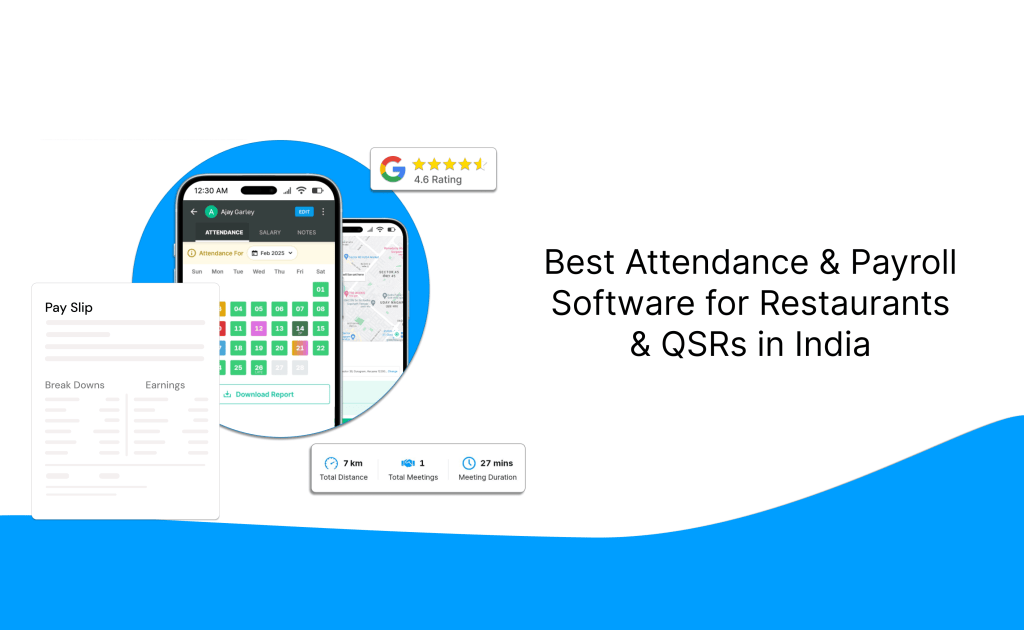
The best attendance and payroll software for restaurants and QSRs in India in 2026 is SalaryBox — a mobile-first platform built for shift-based, high-turnover workforces with AI selfie attendance, GPS geofencing, automated payroll with PF/ESI/TDS, and shift scheduling, starting at under ₹30 per employee/month. India’s restaurant industry faces 80–150% annual staff turnover, making attendance tracking and fast payroll processing critical for retaining workers.
The Indian food services industry is valued at over ₹5.5 lakh crore in 2026 and employs an estimated 7.3 million people across restaurants, QSRs, cloud kitchens, dhabas, and cafes. Yet the vast majority of these establishments — from a standalone biryani joint in Hyderabad to a 40-outlet QSR chain in Mumbai — still rely on paper registers, WhatsApp groups, and manual salary calculations to manage their workforce. The cost of this inefficiency is staggering: incorrect overtime calculations, buddy punching that inflates labour costs by 5–10%, delayed salary payments that drive attrition, and compliance violations that invite penalties from labour inspectors.
Restaurant HR is fundamentally different from office HR. Employees work rotating shifts, often across multiple outlets. Kitchen staff have wet or greasy hands that render fingerprint scanners useless. Daily-wage workers and part-time helpers need different payroll treatment than salaried managers. Split shifts, overtime during festivals, advance salary requests, and tip management add layers of complexity that generic HR software simply cannot handle. Choosing the right attendance and payroll solution is not a back-office decision — it directly impacts staff retention, labour cost control, and regulatory compliance.
This comprehensive guide evaluates the top 8 attendance and payroll software solutions for Indian restaurants and QSRs in 2026. We compare features, pricing, and suitability across different restaurant formats — from single-outlet family restaurants to multi-city QSR chains — so you can make an informed decision that saves time, reduces costs, and keeps your team happy.
Why Do Restaurants Need Specialized HR Software?
Restaurants and QSRs face a unique combination of workforce challenges that make generic HR software inadequate. Unlike office environments with fixed 9-to-5 schedules, restaurants operate across extended hours with rotating shifts, seasonal demand spikes, and a workforce that includes everyone from full-time chefs to part-time weekend servers. Understanding these challenges is essential before selecting the right software solution.
1. Extreme Turnover Rates (80–150% Annually): The restaurant industry has the highest employee turnover of any sector in India. A typical QSR outlet with 15 staff members may hire and lose 12–20 people in a single year. This means onboarding, training, and payroll setup happen almost continuously. Software that makes onboarding slow or complicated simply will not work. Self-onboarding features where new hires enter their own details via a mobile app save hours of administrative work every week.
2. Complex Shift Patterns: Restaurants rarely run a single shift. Most operate with morning prep shifts, lunch rush shifts, afternoon lull periods, evening dinner service, and late-night closing shifts. Many employees work split shifts — coming in for lunch service, leaving for a break, and returning for dinner. Some work different shifts on different days. Software must handle shift assignment, shift swaps, split shift tracking, and overtime calculation across these complex patterns without manual intervention.
3. Daily-Wage and Part-Time Workers: Unlike corporate environments where everyone draws a monthly salary, restaurants employ a mix of salaried managers, monthly-wage kitchen staff, daily-wage helpers, and part-time weekend servers. Each category has different payroll treatment, different minimum wage applicability, and different compliance requirements. The software must support multiple pay structures within a single outlet and calculate wages accurately for each type.
4. Multi-Location Management for Chains and QSRs: A growing QSR brand might have outlets spread across a city or across states. The owner needs a single dashboard to view attendance across all outlets, transfer staff between locations, and generate consolidated payroll reports. State-wise minimum wage differences, different Shops & Establishments Act rules, and varying local holidays add to the complexity. Without centralized software, multi-location management becomes a coordination nightmare.
5. Compliance with Multiple Regulations: Restaurant owners must comply with the Shops & Establishments Act (registration, working hours, weekly off), FSSAI regulations (staff medical fitness certificates, hygiene training records), state-specific minimum wage orders, PF and ESI for establishments with 10/20+ employees, the Child Labour Act (no workers under 14 in commercial kitchens), maternity benefits for women staff including part-time workers, and timely salary payment as mandated under the Payment of Wages Act. A single compliance failure can result in penalties ranging from ₹10,000 to ₹5 lakh depending on the violation.
6. Buddy Punching and Time Theft: In restaurants, buddy punching is rampant. Staff wear similar uniforms, caps, and aprons, making visual identification difficult. Traditional biometric machines fail in kitchen environments — fingerprint scanners do not work with wet, oily, or flour-covered hands, and face recognition machines mounted near hot stoves or steam often malfunction. Time theft through early punch-in and late punch-out can inflate labour costs by 5–10% annually.
7. Cash-Heavy Operations and Salary Tracking: Many restaurants, especially smaller ones, still operate partially in cash. Staff often receive advance payments, tips in cash, or partial salary mid-month. Tracking these advances, deducting them accurately from monthly salary, managing tip pools, and maintaining clean records for tax purposes requires purpose-built payroll features. Generic HR software designed for corporate bank transfers does not address these cash-flow realities.
Top 8 Attendance & Payroll Software for Restaurants in India 2026
We evaluated dozens of HR, attendance, and payroll platforms available in India and shortlisted eight that are either purpose-built for restaurants or have strong features for shift-based, high-turnover workforces. Here is a detailed look at each.
1. SalaryBox — Best Overall for Indian Restaurants
SalaryBox is a mobile-first attendance and payroll app designed specifically for Indian SMBs and shift-based workforces. It stands out as the top choice for restaurants because of its AI selfie attendance that eliminates buddy punching even when staff wear uniforms and caps, GPS geofencing that confirms employees are at the correct outlet, and a complete payroll engine that handles PF, ESI, TDS, overtime, and advance salary deductions automatically.
Key Features:
- AI Selfie Attendance: Employees mark attendance by taking a selfie from their phone. AI liveness detection prevents photo spoofing, and facial recognition confirms identity even with caps, masks, or kitchen uniforms. No hardware needed — works on any Android phone.
- GPS Geofencing: Set a geofence around each outlet. Attendance is only accepted when the employee is physically within the restaurant premises. For multi-outlet chains, each location has its own geofence, and managers can see all outlets on one dashboard.
- Shift Scheduling: Drag-and-drop shift roster for creating weekly or monthly schedules. Support for morning, evening, night, and split shifts. Employees see their upcoming shifts on the app and get notifications for changes.
- Auto Payroll with Compliance: PF, ESI, TDS, professional tax, and overtime are calculated automatically based on attendance data. Supports daily-wage, weekly-wage, and monthly salary structures. Generates payslips that employees can view on their phone.
- Employee Self-Onboarding: New hires download the app, enter their details, upload documents, and are ready to mark attendance within minutes. Critical for restaurants that hire frequently.
- Advance and Loan Tracking: Track salary advances (extremely common in restaurant staff), auto-deduct EMIs from payroll, and maintain a clear ledger visible to both employer and employee.
Pricing: Starts at under ₹30 per employee per month. Free plan available for small teams.
Best For: Single outlets to 50-location chains, QSRs, cloud kitchens, cafes, dhabas, and fine dining restaurants of all sizes across India.
2. POSist — Best POS-Integrated HR
POSist is a cloud-based restaurant management platform that combines POS (point-of-sale), inventory management, and basic HR features in a single platform. Its strength lies in the integration between sales data and staff scheduling, allowing managers to align shift rosters with anticipated demand based on historical POS data.
Key Features:
- Unified POS + HR: Staff scheduling, attendance, and basic payroll are part of the same platform as order management and billing, eliminating data silos.
- Sales-Based Scheduling: The system uses past sales data to recommend optimal staffing levels for different time slots, helping reduce overstaffing during slow periods.
- Tip Management: Built-in tip pooling and distribution features for fine dining restaurants where tip management is critical.
- Multi-Outlet Dashboard: Centralized management across locations with role-based access for outlet managers.
Pricing: Custom pricing (mid-range). HR features are part of the broader POS subscription.
Best For: Fine dining and full-service restaurants that want an all-in-one restaurant management platform and do not need advanced payroll compliance features.
Limitations: No AI-based attendance verification, limited statutory compliance automation, and payroll capabilities are basic compared to dedicated HR platforms.
3. Petpooja — Best for Cloud Kitchens & QSR
Petpooja is an Indian restaurant technology platform that started as a POS system and has expanded to include basic HR and staff management features. It is particularly popular among cloud kitchens and delivery-heavy QSR brands because of its strong integration with food delivery aggregators like Swiggy and Zomato.
Key Features:
- Restaurant-Specific Payroll: Basic payroll features designed around restaurant workflows, including shift-based wage calculation.
- Delivery Staff Management: Track delivery personnel, assign orders, and manage delivery-specific pay structures.
- Multi-Outlet Dashboard: Manage multiple cloud kitchen or QSR outlets from a central dashboard with real-time sales and staff data.
- Aggregator Integration: Deep integration with Swiggy, Zomato, and other delivery platforms for seamless operations.
Pricing: HR features are bundled as part of the POS suite. Contact for pricing.
Best For: Cloud kitchens and delivery-heavy QSRs that need staff management tightly coupled with order management.
Limitations: HR and payroll features are secondary to POS functionality. No advanced attendance verification, limited compliance automation, no standalone HR offering.
4. GreytHR — Best for Compliance-Heavy Restaurant Chains
GreytHR is one of India’s most established HR and payroll platforms, trusted by over 20,000 companies. While it is not restaurant-specific, its robust statutory compliance engine and multi-state payroll capabilities make it an excellent choice for large restaurant chains that operate across multiple states and need airtight compliance.
Key Features:
- Statutory Compliance Engine: Auto-calculates PF, ESI, TDS, professional tax, LWF, and gratuity with state-specific rules. Generates Form 16, PF ECR files, and ESI challans.
- Multi-State Payroll: Handles payroll across states with different minimum wage rates, professional tax slabs, and labour laws — essential for chains operating in multiple states.
- Employee Self-Service Portal: Employees can view payslips, submit leave requests, and update personal information through a web portal.
- Comprehensive Reporting: Extensive payroll, attendance, and compliance reports for audits and management review.
Pricing: Starting at ₹3,495/month for 25 employees. Scales with employee count.
Best For: Restaurant chains with 100+ employees operating across multiple states where statutory compliance is the primary concern.
Limitations: No restaurant-specific features like shift scheduling for split shifts, no AI attendance, no advance/loan tracking. The interface is designed for HR professionals, not restaurant managers.
5. Keka — Best for Growing QSR Chains
Keka is a modern HR platform that has gained popularity among mid-size Indian companies for its clean interface and strong shift management capabilities. For QSR chains that are scaling rapidly and need to professionalize their HR operations, Keka offers a solid balance of features.
Key Features:
- Advanced Shift Management: Create multiple shift templates, assign shifts across locations, manage rotational schedules, and track shift adherence with detailed reports.
- Performance Management: Goal setting, reviews, and feedback cycles — useful for QSR chains building a management pipeline.
- Recruitment Module: Built-in ATS (applicant tracking system) for managing the high volume of hiring that QSR chains require.
- GPS Attendance: Mobile attendance with GPS location capture, though without AI-based face verification.
Pricing: Starting at ₹6,999/month for the base plan. Add-ons for advanced features.
Best For: QSR chains scaling from 50 to 500+ outlets that need recruitment, performance management, and shift scheduling in one platform.
Limitations: Higher price point not suitable for single outlets or small restaurants. No AI selfie attendance. No daily-wage or advance tracking features.
6. HROne — Best for Enterprise Restaurant Groups
HROne is an AI-powered HR platform designed for enterprises and large organizations. Hospitality groups that manage multiple restaurant brands, banquet operations, and catering services can benefit from HROne’s workforce planning and predictive scheduling capabilities.
Key Features:
- AI-Powered Workforce Planning: Predictive analytics to forecast staffing needs based on historical patterns, seasonal trends, and event schedules.
- Predictive Scheduling: AI suggests optimal shift schedules to minimize labour costs while maintaining service quality.
- Enterprise Integrations: Integrates with ERP systems, accounting software, and existing POS platforms used by large hospitality groups.
- Customizable Workflows: Highly configurable approval workflows, policy engines, and organizational hierarchies.
Pricing: Custom pricing based on organization size and modules required.
Best For: Large hospitality groups and enterprise restaurant companies with 500+ employees across multiple brands.
Limitations: Overkill for single outlets or small chains. Implementation can take weeks. Not designed for the informal, fast-moving environment of standalone restaurants.
7. Zoho People — Best Budget Option for Small Restaurants
Zoho People is part of the Zoho ecosystem and offers basic HR, attendance, and leave management at an affordable price point. For small restaurants and cafes with under 15 staff who need simple attendance tracking and basic leave management, Zoho People provides adequate functionality at the lowest price in this list.
Key Features:
- Basic Attendance and Leave Management: Clock-in/clock-out via mobile app or web, leave request and approval workflows, attendance reports.
- Zoho Ecosystem Integration: Seamlessly integrates with Zoho Books for payroll processing, Zoho Expense for expense management, and other Zoho apps.
- Customizable Forms: Create custom forms for onboarding, feedback, and HR processes.
- API Access: Connect with third-party tools through Zoho’s API framework.
Pricing: From ₹48 per employee per month for the Essential plan.
Best For: Single-outlet restaurants, small cafes, and bakeries with under 15 staff who already use or plan to use the Zoho ecosystem.
Limitations: No shift scheduling, no AI attendance, no restaurant-specific features, no daily-wage support. Payroll requires separate Zoho Payroll subscription. Not suitable for multi-location operations.
8. Homebase — Best for International QSR Franchises
Homebase is a US-based workforce management platform specifically built for hourly and shift workers. International QSR franchises operating in India (such as Subway, Domino’s, or McDonald’s franchisees) may already be familiar with Homebase from their global operations. It offers strong scheduling and time tracking features tailored to the quick-service restaurant model.
Key Features:
- Auto-Scheduling: AI-powered scheduling that uses sales data, weather, and local events to predict demand and create optimal schedules.
- Built for Hourly Workers: Every feature is designed around hourly/shift work patterns rather than salaried employees.
- Team Communication: Built-in messaging for shift swaps, announcements, and manager-staff communication.
- Free Tier: Basic scheduling and time tracking available for free for a single location.
Pricing: Free basic plan. Paid plans from $20/location/month.
Best For: International QSR franchise operators in India who want consistency with global brand HR standards.
Limitations: Not designed for Indian compliance (no PF/ESI/TDS). Pricing in USD. Limited India-specific support. No vernacular language support.
Feature Comparison: Restaurant Attendance & Payroll Software
The following table provides a side-by-side comparison of key features across the top five platforms most relevant to Indian restaurant owners. Use this to quickly identify which software matches your specific requirements.
| Feature | SalaryBox | POSist | Petpooja | GreytHR | Keka |
| AI Face Attendance | Yes | No | No | No | No |
| GPS Geofencing | Yes | No | No | No | Yes |
| Shift Scheduling | Yes | Yes | Yes | Basic | Advanced |
| Multi-Location | Yes | Yes | Yes | Yes | Yes |
| Auto Payroll (PF/ESI) | Yes | Basic | Basic | Yes | Yes |
| Overtime Auto-Calc | Yes | No | No | Yes | Yes |
| Employee Self-Service App | Yes | No | No | Yes | Yes |
| Advance/Loan Tracking | Yes | No | No | No | Yes |
| Daily Wage Support | Yes | No | No | No | No |
| Starting Price | <₹30/emp | Custom | POS bundle | ₹3,495/mo | ₹6,999/mo |
| Best For | All restaurants | Fine dining | Cloud kitchen | Large chains | Growing QSRs |
As the comparison shows, SalaryBox offers the most comprehensive feature set at the most accessible price point for Indian restaurants. It is the only platform that combines AI selfie attendance, GPS geofencing, daily wage support, and advance tracking — all features that are essential for the restaurant industry but missing from generic HR platforms.
How to Track Attendance in Restaurants Without Buddy Punching?
Buddy punching — where one employee clocks in on behalf of an absent colleague — is the single biggest attendance fraud issue in restaurants. Industry estimates suggest that buddy punching costs Indian restaurants between 5% and 10% of their total labour budget annually. For a restaurant spending ₹3 lakh per month on staff salaries, that translates to ₹15,000–30,000 lost every month to fraudulent attendance.
Traditional biometric solutions fail in restaurant environments for specific, practical reasons. Fingerprint scanners require clean, dry fingers — impossible in a kitchen where staff constantly handle water, oil, dough, and spices. The error rate for fingerprint recognition increases dramatically with wet or greasy hands, leading to frustration and workarounds (like using a colleague’s finger). Wall-mounted face recognition machines struggle with the heat, steam, and variable lighting conditions found in commercial kitchens. These devices also require a hardware investment of ₹15,000–40,000 per device, with ongoing maintenance costs.
The most effective solution for restaurant attendance in 2026 is AI selfie attendance with liveness detection combined with GPS geofencing. Here is how it works with SalaryBox: the employee opens the SalaryBox app on their personal smartphone and takes a selfie to mark attendance. The AI engine performs liveness detection (verifying that a real person is in front of the camera, not a photograph or video), matches the face against the registered profile photo, and confirms the GPS location falls within the geofenced restaurant premises. The entire process takes under 5 seconds and works reliably regardless of kitchen conditions.
For multi-outlet restaurant chains, the GPS geofencing feature is particularly valuable. Each outlet is geofenced independently, so the system knows exactly which location the employee is at when they punch in. A manager overseeing 10 outlets can view a single dashboard showing real-time attendance across all locations, instantly spotting any outlet that is understaffed. Employees who work at multiple locations (common for area trainers or relief staff) have their hours automatically attributed to the correct outlet for accurate cost allocation.
Shift Management for Restaurants: What Features Should You Look For?
Effective shift management is the backbone of restaurant operations. A poorly planned shift schedule leads to understaffing during peak hours (resulting in poor customer experience and lost revenue), overstaffing during slow periods (wasting labour costs), and employee dissatisfaction from unpredictable or unfair scheduling. Here are the critical shift management features that restaurant owners should demand from their HR software.
Split Shift Support: Many restaurant employees work split shifts — a morning session from 10 AM to 2 PM and an evening session from 6 PM to 11 PM, with a break in between. The software must track each segment separately, calculate total hours correctly, and apply overtime rules based on cumulative daily hours, not per-segment hours.
Shift Swap with Manager Approval: Employees frequently need to swap shifts due to personal commitments. A good system allows employees to request swaps through the app, routes the request to the manager for approval, and automatically updates the roster once approved. This reduces WhatsApp chaos and ensures managers maintain control over staffing levels.
Overtime Auto-Tracking: Indian labour law mandates overtime pay at twice the ordinary rate for hours worked beyond the regular schedule. The software must automatically detect overtime hours, calculate the premium, and include it in payroll without any manual intervention. For restaurants, overtime is particularly common during weekend rushes, festivals (Diwali, Eid, Christmas), and special events.
Break Time Management: Track meal breaks and rest breaks separately from working hours. Ensure that legally mandated breaks are provided and logged. This is especially important for audits under the Shops & Establishments Act.
Demand-Based Scheduling: The best restaurant scheduling tools allow managers to create templates for regular weeks and modified schedules for high-demand periods like weekends, festival seasons, cricket match days (which spike delivery orders), and wedding seasons. SalaryBox allows managers to create and save multiple schedule templates that can be applied with one tap.
Shift Handover Notes: For restaurants that run continuous service, shift handover notes help the incoming team understand pending tasks, customer complaints, inventory issues, or equipment problems from the previous shift. While not all HR software includes this, it is a valuable feature for maintaining operational continuity.
SalaryBox handles multi-shift rostering with a visual drag-and-drop interface that lets managers create weekly schedules in minutes rather than hours. Employees receive their schedules on the app, reducing the common complaint of not knowing tomorrow’s shift timings. The system also flags conflicts such as scheduling an employee for a morning shift after a late-night closing shift, helping managers avoid scheduling fatigue-related issues.
Compliance Checklist for Restaurant Owners in India
Restaurant owners in India must navigate a complex web of labour laws, food safety regulations, and employment rules. Non-compliance can result in hefty fines, license revocation, or even criminal proceedings. The following checklist maps every major compliance area to the specific software feature you need to stay compliant.
| Compliance Area | Requirement | Software Feature Needed |
| Shops & Establishments Act | Registration, working hours limits, mandatory weekly off, overtime limits | Attendance tracking with daily/weekly hour reports, overtime alerts |
| Minimum Wages Act | State-wise minimum wage rates, timely payment, equal pay | Auto payroll with state-specific minimum wage rules configured |
| PF (Provident Fund) | Mandatory for 10+ employees, 12% employer + 12% employee contribution | Auto PF deduction, ECR file generation, monthly challan calculation |
| ESI (Employee State Insurance) | Mandatory for 20+ employees, applicable if salary under ₹21,000 | Auto ESI deduction, contribution tracking, filing assistance |
| FSSAI Regulations | Staff medical fitness certificates, food safety training records | Document management module for storing and tracking certificate expiry |
| Child Labour Act | No workers under 14 in commercial establishments | Age verification field in onboarding with date-of-birth validation |
| Maternity Benefit Act | 26 weeks paid leave for women, applicable even to part-time staff | Leave management with maternity leave type and eligibility tracking |
| Payment of Wages Act | Salary must be paid by 7th of following month for under 1,000 employees | Payroll scheduling with reminders and automated processing dates |
SalaryBox simplifies compliance by automating PF and ESI calculations, generating filing-ready reports, tracking document expiry dates, and ensuring payroll is processed on schedule. For restaurant owners who are not HR experts — which is the vast majority — this automation is the difference between compliance and costly violations.
One often-overlooked compliance area for restaurants is the maintenance of attendance registers and wage records. Under the Shops & Establishments Act, employers must maintain Form-A (register of employees), Form-D (attendance register), and wage registers that can be produced during a labour inspector’s visit. Digital attendance records generated by SalaryBox serve as legally valid documentation, and the app generates formatted reports that can be printed for inspection purposes.
Frequently Asked Questions: Restaurant Attendance & Payroll Software
Which is the best attendance app for restaurants in India?
SalaryBox is the best attendance app for restaurants in India in 2026. It offers AI selfie-based attendance with liveness detection that prevents buddy punching, GPS geofencing for multi-outlet location verification, shift scheduling for complex restaurant rosters, and automated payroll with PF/ESI/TDS compliance. It works on any Android phone without requiring hardware installation, making it ideal for kitchen environments.
How do restaurants track employee attendance?
Restaurants track employee attendance using mobile-based AI selfie apps (most reliable for kitchen environments), POS-integrated systems and time clocks, biometric devices (less effective in kitchens due to wet hands), or paper registers (least accurate). The recommended method in 2026 is AI selfie attendance with GPS geofencing, as used by SalaryBox, which works regardless of kitchen conditions and prevents buddy punching without expensive hardware.
How much does payroll software cost for restaurants in India?
Payroll software for Indian restaurants ranges from free basic plans to ₹6,999+ per month. SalaryBox starts under ₹30 per employee per month with a free tier for small teams. GreytHR starts at ₹3,495/month for 25 employees. Keka starts at ₹6,999/month. POS-integrated options like POSist and Petpooja bundle HR features into their POS subscription. For most restaurants, SalaryBox offers the best value with restaurant-specific features at the lowest per-employee price.
Can restaurant staff use mobile attendance?
Yes, mobile attendance is the ideal solution for restaurant staff. Apps like SalaryBox allow employees to mark attendance using their personal Android phone with an AI selfie. This eliminates the need for fingerprint scanners (which fail with wet or greasy kitchen hands) and expensive wall-mounted devices. Mobile attendance combined with GPS geofencing ensures the employee is physically at the restaurant when marking attendance.
How to manage shifts for restaurant employees?
Managing shifts for restaurant employees requires software with multi-shift templates (morning, evening, night, split), drag-and-drop rostering, shift swap functionality with manager approval, overtime auto-detection, and mobile notifications so staff know their schedule in advance. SalaryBox provides all these features with a visual interface that lets managers create weekly rosters in minutes and push schedules to employees’ phones instantly.
Is PF mandatory for restaurant workers in India?
PF (Provident Fund) is mandatory for restaurant establishments with 20 or more employees. The employer contributes 12% of basic salary, and an equal 12% is deducted from the employee’s salary. For establishments with 10–19 employees, PF registration is optional but recommended. SalaryBox and GreytHR both automate PF calculations, generate ECR files for online filing, and produce monthly challans to ensure timely compliance.
How to prevent buddy punching in restaurants?
The most effective way to prevent buddy punching in restaurants is AI selfie attendance with liveness detection. Unlike fingerprint scanners (which fail with wet/greasy hands) or PIN codes (easily shared), AI selfie attendance verifies the employee’s identity through facial recognition and liveness checks that prevent photo spoofing. SalaryBox’s AI selfie attendance combined with GPS geofencing ensures the right person is at the right place at the right time.
Which software is best for multi-outlet restaurant chains?
For multi-outlet restaurant chains in India, SalaryBox is the best choice for chains with up to 50 locations due to its per-employee pricing, multi-location dashboard, and GPS geofencing for each outlet. GreytHR is better suited for 100+ employee chains that need advanced statutory compliance across states. Keka works well for growing QSR chains that also need recruitment and performance management. POSist is ideal if you want POS and HR in a single platform.
