
Attendance & Payroll Management for Hotels & Hospitality in India: Complete Guide 2026
What Does Attendance & Payroll Management for Hotels Involve?
Attendance and payroll management for hotels and hospitality businesses in India refers to the end-to-end process of tracking employee work hours across multiple shifts, calculating wages that account for overtime, night differentials, tips, and service charges, and ensuring statutory compliance with PF, ESI, TDS, and state-specific labour laws. Hotels are uniquely complex because they operate 24 hours a day, 365 days a year, with staff spread across departments such as front desk, food and beverage, housekeeping, banquets, spa, and security. Seasonal demand fluctuations during wedding seasons and festivals mean workforce sizes can double temporarily, requiring rapid onboarding and payroll adjustments.
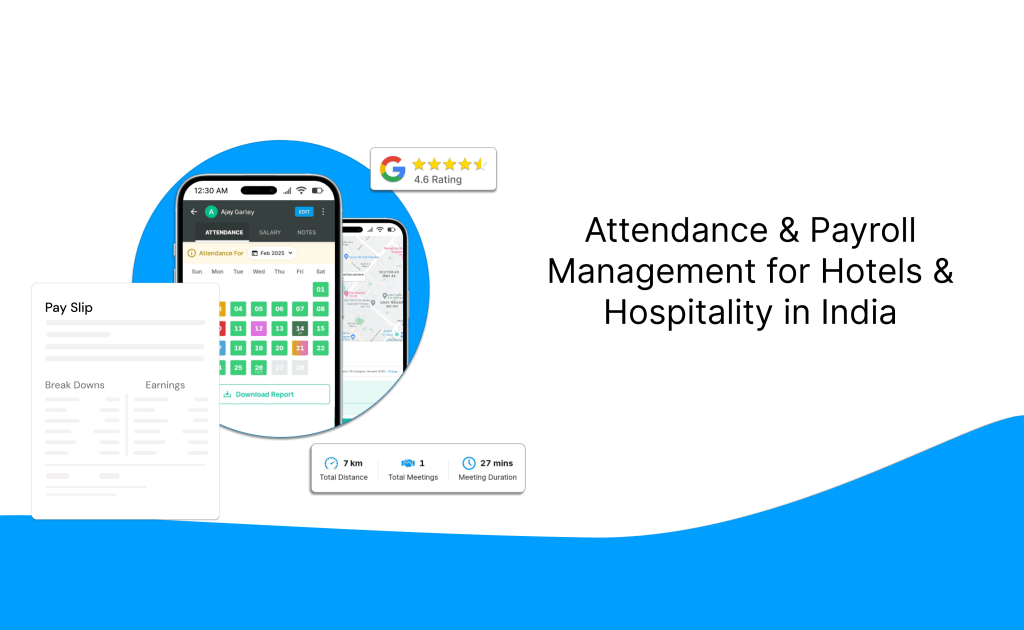
India’s hospitality industry employs over 40 million people, yet the sector faces a shortage of approximately 150,000 trained professionals and an attrition rate exceeding 40 percent. These numbers make accurate, automated attendance and payroll not just a convenience but a business necessity. Manual registers and spreadsheets create errors, invite buddy punching, and make compliance audits a nightmare. Modern solutions like SalaryBox offer mobile-first attendance tracking with AI selfie verification and GPS geofencing, automated payroll with built-in PF, ESI, and TDS calculations, and multi-location management from a single dashboard. For hotels that need to manage split shifts, rotational rosters, contract staff, and tip distribution, the right software eliminates hours of administrative work every pay cycle and reduces compliance risk significantly.
This comprehensive guide covers everything hotel owners, HR managers, and hospitality chains need to know about attendance and payroll management in 2026, from compliance requirements and shift management strategies to software comparisons and decision frameworks based on hotel size.
Why Is Hotel Payroll More Complex Than Other Industries?
Hotel payroll is widely considered one of the most challenging payroll environments in India. Unlike a standard 9-to-5 office, hotels must manage multiple overlapping variables that directly affect wage calculations. Below are the eight primary complexities that make hotel payroll distinctly difficult.
1. 24/7 Shift Rotations Across Three or More Shifts
Hotels never close. Staff work across morning (6 AM to 2 PM), afternoon (2 PM to 10 PM), and night (10 PM to 6 AM) shifts, seven days a week. Rotational scheduling means the same employee may work different shifts in the same week. Payroll must track each shift’s hours separately, apply night shift allowances, and calculate weekly rest day compliance under the Shops and Establishments Act. A single miscalculation in shift assignment can cascade into overtime errors across the entire pay period.
2. Split Shifts Common in Food & Beverage
Restaurants and banquet departments frequently require split shifts where a cook or server works the breakfast rush from 7 AM to 11 AM, takes an unpaid break, and returns for dinner service from 6 PM to 11 PM. Tracking actual working hours versus total hours on premises is critical for correct wage computation. Split shifts also complicate overtime calculations since the gap period may or may not count toward the daily hour threshold depending on state-specific rules.
3. Seasonal Workforce Fluctuations
India’s wedding season from October to February and festival periods like Diwali and Navratri can double a hotel’s staffing needs practically overnight. Hotels in tourist destinations such as Goa, Rajasthan, and Kerala see dramatic seasonal swings. Temporary staff must be onboarded quickly, their PF and ESI registrations completed, attendance tracked from day one, and full-and-final settlements processed when the season ends. This constant churn creates significant administrative burden.
4. Tips and Service Charge Distribution
Many Indian hotels add a service charge of 5 to 10 percent on bills. This must be pooled and distributed among eligible staff according to predefined department-wise formulas. Tips received directly by staff have different tax treatment than service charges collected by the establishment. Payroll systems must separately track, calculate, and report these amounts. Errors in distribution can lead to employee disputes and tax compliance issues.
5. Multi-Department Payroll With Varying Pay Structures
A single hotel may have six or more departments: rooms division, food and beverage, housekeeping, banquets and events, spa and wellness, and security. Each department has different pay grades, different shift patterns, different overtime eligibility rules, and different service charge distribution ratios. The chef de cuisine has a vastly different compensation structure than a room attendant, yet both must be processed accurately in the same payroll cycle.
6. High Attrition Rates Exceeding 40 Percent
The Indian hospitality sector has one of the highest attrition rates of any industry, with annual turnover regularly exceeding 40 percent. Many hotels currently operate at just 60 to 70 percent of their ideal staffing levels due to a shortage of trained professionals. This means payroll teams are constantly processing new joiners, exits, full-and-final settlements, and experience letter requests. Each exit requires gratuity calculation if applicable, leave encashment, notice period adjustments, and PF transfer documentation.
7. Contract and Outsourced Staff Alongside Permanent Employees
Hotels commonly employ a mix of permanent staff, contract workers through staffing agencies, daily-wage casual labour for events, and outsourced services for security and housekeeping. Each category has different payment terms, compliance requirements, and attendance tracking needs. Contract staff may be on the contractor’s payroll but work under the hotel’s supervision, creating dual compliance obligations under the Contract Labour Act.
8. State-Wise Minimum Wage Variations
India does not have a single national minimum wage for hospitality workers. Rates vary dramatically by state and skill category. A hotel chain operating in Rajasthan, Kerala, and Maharashtra must apply three different minimum wage schedules. Rajasthan may set unskilled hotel worker wages at approximately Rs 8,500 per month, while Kerala’s rates for comparable roles can exceed Rs 12,000. Each state also has different Professional Tax slabs, adding another layer of calculation complexity.
Manual vs Software-Based Attendance & Payroll: How Do They Compare?
The following table compares manual register and spreadsheet-based attendance and payroll management against dedicated software solutions like SalaryBox across 12 critical parameters relevant to hotel operations.
| Parameter | Manual / Spreadsheet | Software (e.g., SalaryBox) |
| Shift Tracking | Paper registers; error-prone with 3+ shifts | Automated shift assignment with rotation templates |
| Attendance Marking | Sign-in sheets; buddy punching common | AI selfie with liveness detection; GPS geofencing |
| Overtime Calculation | Manual tallying; frequent errors | Auto-calculated based on shift rules and state laws |
| Split Shift Handling | Very difficult to track accurately | Separate clock-in/out per split with gap tracking |
| Payroll Processing Time | 3-5 days per cycle for 100 employees | Under 1 hour with auto-calculation |
| PF/ESI Compliance | Manual calculation and filing | Auto-computed with challan generation |
| Multi-Location Mgmt | Separate registers per property | Single dashboard for all locations |
| Service Charge Tracking | Manual pooling and distribution | Automated distribution by department formula |
| Employee Self-Service | Not available | Mobile app for payslips, leave requests, attendance |
| Audit Readiness | Paper trail; hard to retrieve | Digital records with instant report generation |
| Error Rate | High (5-10% in manual calculations) | Near zero with automated validation |
| Cost for 50 Employees | Hidden costs: time, errors, penalties | Starting free for small teams; scales affordably |
As the table illustrates, software-based solutions eliminate the most time-consuming and error-prone aspects of hotel payroll management. For properties with even 20 or more employees, the return on investment from reduced errors and compliance penalties alone typically justifies the subscription cost within the first month.
What Are the Key Compliance Requirements for Hotel Payroll in India?
Hotels in India must comply with a complex web of central and state-level labour laws. Non-compliance can result in penalties ranging from Rs 10,000 to Rs 5 lakh per violation, along with potential prosecution of the establishment’s principal employer. Below is a detailed breakdown of each major compliance area.
Shops and Establishments Act (State-Wise Registration)
Every hotel must register under its respective state’s Shops and Establishments Act within 30 days of commencing operations. This registration governs working hours, rest intervals, weekly holidays, overtime limits, and conditions of service. Requirements vary by state: Maharashtra limits hotel work hours to 9 per day and 48 per week, while some states allow 10 hours per day for seasonal operations. Failure to register can result in fines and closure orders.
Minimum Wages Act (Skill-Grade Based)
Hotels must pay at least the minimum wage applicable to each employee’s skill grade and state. A cook classified as skilled labour has a different minimum wage than a housekeeping attendant classified as semi-skilled. Wage schedules are typically revised every six months to one year. Hotels operating across multiple states must track and apply the correct rate for each location. SalaryBox helps by maintaining updated minimum wage tables and flagging any employee whose compensation falls below the applicable threshold.
Provident Fund (PF) Contributions
Establishments with 20 or more employees must register under the Employees’ Provident Fund and Miscellaneous Provisions Act. Both employer and employee contribute 12 percent of basic wages plus dearness allowance. The employer’s 12 percent is split into 8.33 percent for the Employees’ Pension Scheme (EPS) and 3.67 percent for the EPF account. Monthly electronic challans must be filed by the 15th of the following month. Late filing attracts interest at 12 percent per annum and damages up to 100 percent of arrears.
ESI (Employees’ State Insurance)
For employees earning gross wages up to Rs 21,000 per month, ESI registration is mandatory for establishments with 10 or more employees in most states. The employer contributes 3.25 percent and the employee contributes 0.75 percent of gross wages. ESI provides medical benefits, sickness cash benefits, maternity benefits, and disability coverage. Given the physical nature of hotel work including kitchen burns, slips, and repetitive strain, ESI compliance is especially important in hospitality.
Professional Tax
Professional Tax is a state-level tax deducted from employee salaries. Rates and slabs vary significantly: Maharashtra charges Rs 200 per month for salaries above Rs 10,000, while Karnataka has a graduated slab structure. Some states like Rajasthan do not levy Professional Tax. Hotels must register as employers in each applicable state and deduct the correct amount from each employee’s salary.
Payment of Bonus Act
All employees earning up to Rs 21,000 per month are entitled to an annual bonus of 8.33 percent of wages (minimum) up to 20 percent (maximum). Hotels must calculate and pay bonus within 8 months of the close of the accounting year. The calculation basis, eligibility criteria, and allocable surplus computations make this one of the more complex annual compliance requirements.
Payment of Gratuity Act
Employees who have completed five or more years of continuous service are entitled to gratuity at the rate of 15 days wages for each completed year of service. Given the hospitality sector’s high attrition, many employees do not complete five years. However, hotels must maintain gratuity provisions in their books and process payments promptly for those who qualify. The maximum gratuity payable is Rs 25 lakh.
Overtime Rules
Overtime wages must be paid at twice the ordinary rate of wages in most states for hours worked beyond the daily or weekly threshold. Hotels must maintain an overtime register showing the date, employee name, hours of overtime, and rate paid. Night shift workers may be entitled to additional allowances depending on state rules. Accurate shift tracking is essential to ensure overtime is correctly identified and compensated.
Hotel Payroll Compliance Checklist
| Compliance Area | Frequency | Key Deadline |
| PF Challan Filing | Monthly | 15th of next month |
| ESI Contribution | Monthly | 15th of next month |
| TDS on Salary (24Q) | Quarterly | 31st of quarter-end month |
| Professional Tax | Monthly/Annual | Varies by state |
| Minimum Wage Review | Semi-Annual | On government notification |
| Bonus Payment | Annual | Within 8 months of year-end |
| Gratuity Provisioning | Ongoing | On employee exit (5+ years) |
| Shops & Estab. Renewal | Annual | Before license expiry date |
| Labour Welfare Fund | Semi-Annual | June 30 and December 31 |
| Equal Remuneration Records | Ongoing | Available on inspection |
Maintaining compliance across all these areas manually is extremely difficult for hotels with even moderate staff sizes. Automated payroll platforms like SalaryBox handle PF, ESI, and TDS calculations automatically, generate challans and returns, and send alerts before filing deadlines, significantly reducing the risk of penalties.
How to Manage Shift-Based Attendance in Hotels?
Effective shift-based attendance management is the foundation of accurate hotel payroll. Without reliable attendance data, every downstream calculation, from overtime to service charge distribution, becomes unreliable. Here is how hotels can implement robust shift attendance tracking.
What Shift Types Must Hotels Track?
- Morning Shift (6 AM to 2 PM): Front desk check-outs, breakfast service, housekeeping room turnover
- Afternoon Shift (2 PM to 10 PM): Check-ins, lunch and dinner service, evening events
- Night Shift (10 PM to 6 AM): Night audit, security, late check-ins, kitchen prep
- Split Shift: Typically breakfast plus dinner service with a 4-6 hour unpaid break
- Rotational Shift: Employees rotate through different shifts on a weekly or bi-weekly basis
Each shift type requires separate attendance tracking with clear clock-in and clock-out times. The system must differentiate between scheduled shift hours and actual hours worked to calculate overtime, late arrivals, and early departures accurately.
How Does AI Selfie Attendance Prevent Buddy Punching?
Buddy punching, where one employee clocks in on behalf of an absent colleague, is estimated to cost Indian businesses 2 to 5 percent of total payroll annually. In hotels, where staff may work in remote areas like basements, rooftops, or satellite properties, traditional biometric systems with fixed terminals are often impractical. SalaryBox’s AI selfie attendance requires each employee to take a live selfie with their smartphone at the time of clocking in. The system uses facial recognition with liveness detection to verify identity, ensuring the person is physically present and not using a photograph. The selfie is timestamped and geotagged, creating an indisputable attendance record.
How Does GPS Geofencing Work for Multi-Property Hotel Chains?
Hotel chains managing multiple properties need to ensure employees are at their assigned location when they clock in. GPS geofencing creates a virtual boundary around each hotel property. When an employee attempts to mark attendance, the system verifies their GPS coordinates fall within the designated geofence for their assigned location. SalaryBox allows hotels to set up multiple geofences with customizable radii, accommodating everything from a single-building boutique hotel to a sprawling resort with multiple attendance zones across the campus.
How Is Overtime Auto-Calculated for Hotel Shifts?
Overtime in hotels is triggered when an employee works beyond the daily shift duration (typically 8 or 9 hours) or exceeds weekly hour limits (48 hours in most states). The system must automatically identify overtime hours by comparing actual clock-in and clock-out times against scheduled shift durations. Double-rate overtime (2x the ordinary rate) must be applied per most state rules. Night shift workers may also earn a night differential. Automated calculation eliminates the manual tallying that leads to frequent errors and employee grievances.
How to Track Breaks During Split Shifts?
Split shift tracking requires the system to handle multiple clock-in and clock-out events per employee per day. A cook working breakfast from 7 AM to 11 AM and dinner from 6 PM to 11 PM should show two separate work periods totaling 9 hours, with the 7-hour gap excluded from working time. The system must aggregate these separate periods for daily and weekly totals, correctly identify whether the total triggers overtime, and maintain clear records for each segment. SalaryBox supports multiple attendance entries per day per employee, making split shift tracking straightforward.
How to Handle Tips and Service Charge in Hotel Payroll?
Tips and service charges represent a significant portion of hotel employee compensation in India. However, their tax treatment, distribution rules, and record-keeping requirements are distinctly different. Hotels must handle both correctly to avoid employee disputes and tax complications.
What Is the Difference Between Tips and Service Charges?
Tips are voluntary payments made directly by guests to individual staff members. Service charges are amounts added to bills by the hotel, typically 5 to 10 percent, which the hotel collects and then distributes to staff. While the Supreme Court and various consumer forums have clarified that service charges are not mandatory for guests, most hotels continue the practice. The key distinction is that tips go directly to the employee and are largely unreported, while service charges flow through the hotel’s accounts and must be formally distributed and documented.
How Should Service Charges Be Pooled and Distributed?
Most hotels pool all service charges collected during a period and distribute them according to department-wise formulas. A common distribution model allocates shares based on department and seniority. Food and beverage staff, who directly generate service charges, typically receive the largest share (40-50 percent of the pool). Front office, housekeeping, and kitchen staff receive smaller shares. Management above a certain grade is often excluded. The hotel must maintain transparent records of total collection, distribution formula, and individual disbursements.
What Is the Tax Treatment of Tips vs Service Charges?
- Tips: Technically taxable as income for the employee, but direct cash tips are rarely reported. The Income Tax Act requires employees to declare all income including tips.
- Service Charges Distributed to Employees: These are treated as part of the employee’s salary or wages for income tax purposes. TDS must be deducted at the applicable slab rate. They are also included in the calculation base for PF and ESI if they form a regular part of compensation.
- Service Charges Retained by Hotel: If the hotel retains any portion, it is treated as the hotel’s revenue and subject to GST and income tax at the corporate rate.
What Records Must Hotels Maintain for Tips and Service Charges?
Hotels should maintain daily service charge collection registers showing total bills, service charge percentage applied, and amounts collected. Distribution records should show the formula used, eligible employees, each employee’s share, and payment date. Payslips should clearly show service charge distributions as a separate line item. For audit purposes, the trail from collection to distribution must be fully traceable. SalaryBox allows hotels to add custom earning heads for service charge distribution, ensuring it appears correctly on payslips and in compliance calculations.
What Are the Top 8 Attendance & Payroll Software for Hotels in India in 2026?
Choosing the right attendance and payroll software is critical for hotel operations. Below is a detailed review of eight leading platforms, evaluated specifically for their suitability in Indian hospitality environments.
1. SalaryBox
SalaryBox is a mobile-first attendance and payroll application designed specifically for Indian SMBs. Its standout feature for hotels is AI selfie attendance with liveness detection, which eliminates buddy punching without requiring expensive biometric hardware. GPS geofencing supports multi-property chains, allowing managers to track attendance across locations from a single dashboard. Payroll is automated with built-in PF, ESI, and TDS calculations, challan generation, and state-wise Professional Tax handling. The app is available in 12 Indian languages and is free for businesses with up to 25 employees. For hotels, SalaryBox’s advantages include multi-shift scheduling, overtime auto-calculation, and an employee self-service app where staff can view payslips, submit leave requests, and check attendance history. The platform processes payroll in minutes rather than days, and its cloud-based architecture means hotel owners can run payroll from anywhere.
2. IDS Next
IDS Next is a hospitality-specific technology company offering FX GeM, an integrated hotel management platform. Its staff management module integrates directly with the property management system (PMS), connecting room occupancy data with staffing requirements. The platform handles shift scheduling, attendance tracking, and payroll within the broader hotel operations ecosystem. Best suited for mid-to-large hotels that want a single vendor for PMS and HR operations, IDS Next’s pricing is custom and typically enterprise-level.
3. Hotelogix
Hotelogix is a cloud-based hotel PMS that includes staff management capabilities. While primarily a property management system, its staff module covers basic attendance tracking, shift scheduling, and simple payroll functions. It is best suited for small to mid-size hotels that want a unified PMS and staff management system without investing in separate HR software. Payroll compliance features are limited compared to dedicated payroll platforms, so hotels with 50 or more employees may need supplementary compliance tools.
4. GreytHR
GreytHR is a comprehensive HR and payroll platform widely used across Indian industries. For hotels, it offers shift management with configurable shift types, attendance tracking via biometric integration or mobile app, and robust payroll processing with full PF, ESI, and TDS compliance. GreytHR’s strength is its compliance depth, with auto-generated challans, returns, and statutory reports. It supports multi-location payroll and has a self-service portal for employees. Pricing starts at approximately Rs 3,495 per month for 50 employees.
5. Keka
Keka positions itself as a modern workforce management platform with strong attendance and payroll capabilities. It offers GPS-based attendance, configurable shift patterns, and an automated payroll engine with compliance handling. Keka’s interface is modern and user-friendly, with good reporting and analytics. For hotels, it supports multi-shift environments and has basic overtime calculation features. However, it is not hospitality-specific, so features like service charge distribution require custom configuration. Pricing is approximately Rs 6,999 per month for up to 100 employees.
6. HROne
HROne is an enterprise HR platform with strong multi-location support, making it relevant for hotel chains. It offers attendance management, leave tracking, payroll processing, and compliance management across multiple entities and locations. HROne’s workflow automation handles approval hierarchies common in hotel chains. Its expense management module is useful for hotels managing travel and event budgets. Pricing is custom and generally suited for mid-size to large organizations with 200 or more employees.
7. Zoho People
Zoho People, part of the Zoho ecosystem, offers customizable shift scheduling that can accommodate complex hotel rosters. Its attendance module supports multiple clock-in methods including mobile app with geofencing. Integration with Zoho Payroll adds automated salary processing with Indian compliance support. Zoho People’s advantage is its deep integration with other Zoho products such as Zoho Books for accounting and Zoho Desk for internal helpdesk. Pricing starts at Rs 60 per employee per month, making it cost-effective for hotels with moderate staff sizes.
8. BambooHR
BambooHR is an international HR platform with a growing presence in India. It excels at employee lifecycle management, from onboarding to offboarding, which is particularly valuable given the hospitality industry’s high turnover. Its time-tracking and attendance features are functional but less suited to complex multi-shift environments. Indian compliance features are available through partner integrations rather than natively. BambooHR is best suited for hotel chains with international operations that need a global HR platform with some India-specific capabilities.
Feature Comparison: How Do the Top 8 Hotel Payroll Software Stack Up?
The following table compares all eight platforms across the features most critical for hotel attendance and payroll management in India.
| Feature | SalaryBox | IDS Next | Hotelogix | GreytHR |
| Shift Scheduling | Yes (multi-shift) | Yes (PMS-linked) | Basic | Yes (configurable) |
| AI Selfie Attendance | Yes (liveness) | No | No | No |
| GPS Geofencing | Yes (multi-zone) | Limited | No | Yes |
| Split Shift Support | Yes | Yes | Basic | Manual config |
| Tip/Service Charge | Custom heads | Integrated | Basic | Custom heads |
| PF/ESI Auto-Calc | Yes | Partner | No | Yes |
| Multi-Location | Yes | Yes | Yes | Yes |
| Mobile App | Android + iOS | Web-based | Web-based | Android + iOS |
| Free Tier | Up to 25 employees | No | No | No |
| Best For | SMB hotels | Large hotels | Small hotels | Mid-size+ |
| Feature | Keka | HROne | Zoho People | BambooHR |
| Shift Scheduling | Yes | Yes | Yes (custom) | Basic |
| AI Selfie Attendance | No | No | No | No |
| GPS Geofencing | Yes | Yes | Yes | Limited |
| Split Shift Support | Manual config | Yes | Configurable | No |
| Tip/Service Charge | Custom config | Custom config | Custom fields | No |
| PF/ESI Auto-Calc | Yes | Yes | Via Zoho Payroll | Partner |
| Multi-Location | Yes | Yes (strong) | Yes | Yes |
| Mobile App | Android + iOS | Android + iOS | Android + iOS | Android + iOS |
| Free Tier | No | No | No | No |
| Best For | Mid-size biz | Chains 200+ | Zoho users | International chains |
SalaryBox stands out as the only platform offering AI selfie attendance with liveness detection and a free tier for small hotels. For budget hotels and standalone restaurants with fewer than 25 employees, it provides enterprise-grade attendance and payroll at zero cost. Larger properties benefit from its multi-location dashboard and automated compliance.
How to Choose the Right Attendance & Payroll Software for Your Hotel?
The right software depends primarily on your hotel’s size, number of locations, and existing technology stack. Below is a decision framework organized by hotel category.
Budget Hotels and Standalone Restaurants (Under 50 Staff)
- Primary Need: Simple, affordable attendance tracking with basic payroll and compliance
- Key Challenge: Limited HR staff (often the owner handles payroll personally)
- Recommended: SalaryBox (free for up to 25 employees, mobile-first, minimal training needed)
- Why It Works: AI selfie attendance eliminates hardware costs, automated payroll saves 3-4 days per month, and the mobile-first design means the owner can manage everything from their phone between managing operations
Mid-Size Hotels (50-200 Staff)
- Primary Need: Multi-shift scheduling, compliance automation, departmental payroll management
- Key Challenge: Multiple departments with different pay structures and shift patterns
- Recommended: SalaryBox Pro, GreytHR, or Zoho People (depending on existing software ecosystem)
- Why It Works: These platforms offer the shift complexity handling and compliance depth needed for multiple departments while remaining affordable. Integration with accounting software streamlines financial reporting.
Hotel Chains (200+ Staff Across Multiple Properties)
- Primary Need: Multi-location management, centralized payroll with location-specific compliance, scalable architecture
- Key Challenge: Standardizing processes across properties while accommodating state-wise compliance variations
- Recommended: SalaryBox Enterprise, HROne, or IDS Next (for those wanting PMS integration)
- Why It Works: Enterprise platforms provide centralized dashboards, role-based access for property-level HR managers, and consolidated compliance reporting across all locations.
Key Evaluation Criteria Regardless of Hotel Size
- Shift flexibility: Can the system handle morning, afternoon, night, split, and rotational shifts?
- Attendance reliability: Does it prevent buddy punching through biometric, AI selfie, or GPS verification?
- Compliance coverage: Does it auto-calculate PF, ESI, TDS, and Professional Tax for your state?
- Mobile access: Can managers and employees access the system from their smartphones?
- Integration: Does it connect with your existing PMS, accounting, or banking software?
- Support: Is customer support available in your preferred language and timezone?
- Scalability: Can the platform grow with your business without requiring migration?
Frequently Asked Questions About Hotel Attendance & Payroll
1. Is attendance software mandatory for hotels in India?
While no law specifically mandates attendance software, the Shops and Establishments Act requires hotels to maintain accurate records of employee working hours, overtime, and rest periods. Digital attendance systems like SalaryBox create legally compliant records automatically, whereas manual registers are prone to errors and difficult to produce during labour inspections.
2. How can hotels prevent buddy punching across multiple shifts?
The most effective method is AI selfie attendance with liveness detection, as offered by SalaryBox. This requires the employee to take a live selfie at the time of clocking in, which is verified using facial recognition. Combined with GPS geofencing that confirms the employee is at the correct property, buddy punching becomes virtually impossible without the cost of installing biometric hardware at every location.
3. What is the PF contribution rate for hotel employees in 2026?
The PF contribution rate remains 12 percent from the employee and 12 percent from the employer, calculated on basic wages plus dearness allowance. Of the employer’s 12 percent, 8.33 percent goes to the Employees’ Pension Scheme and 3.67 percent to the EPF account. Establishments with 20 or more employees must register. All hotel staff regardless of department are covered if they earn basic wages up to Rs 15,000 per month.
4. How should hotels handle payroll for contract housekeeping and security staff?
Contract staff are technically on the contractor’s payroll, but the principal employer (the hotel) has supervisory compliance obligations under the Contract Labour (Regulation and Abolition) Act. Hotels should verify that contractors are registered, maintain records of contractor employee wages and attendance, and ensure PF and ESI contributions are being made. Some hotels use SalaryBox to maintain a parallel attendance record for contract staff to protect against disputes.
5. Are service charges distributed to staff taxable?
Yes. Service charges distributed to employees are treated as income and are subject to TDS at the applicable slab rate. They should be included in the employee’s Form 16 at the end of the financial year. Whether service charge distributions are included in the PF and ESI calculation base depends on whether they are paid regularly and form a significant portion of compensation. Hotels should consult their compliance advisor and ensure their payroll software handles the categorization correctly.
6. What are the overtime rules for hotel employees in India?
Under most state Shops and Establishments Acts, hotel employees working beyond the daily threshold (typically 8 or 9 hours) or weekly threshold (48 hours) are entitled to overtime wages at twice the ordinary rate. Night shift workers in some states receive additional allowances. The total working hours including overtime generally cannot exceed 10 to 12 hours per day. Hotels must maintain an overtime register and ensure overtime does not become a regular practice, as regulators may view systematic overtime as understaffing.
7. Can a single software manage payroll for a hotel chain across different states?
Yes. Platforms like SalaryBox, GreytHR, and HROne support multi-location payroll with state-specific compliance rules. They can apply different minimum wage rates, Professional Tax slabs, and Shops and Establishments Act rules based on each property’s state. SalaryBox allows hotel chains to manage all properties from a single dashboard while maintaining separate compliance calculations for each state, generating location-wise reports and consolidated group-level analytics.
8. What is the best free attendance and payroll software for small hotels?
SalaryBox offers a genuinely free plan for hotels with up to 25 employees, making it the leading choice for budget hotels, standalone restaurants, and small hospitality businesses. The free plan includes AI selfie attendance, GPS geofencing, automated payroll with PF and ESI calculations, and employee self-service via mobile app. Unlike trial periods offered by other vendors, the SalaryBox free tier is permanent and fully functional, allowing small hotels to access enterprise-grade attendance and payroll management without any financial commitment.
Conclusion
Attendance and payroll management for hotels in India is inherently complex, driven by 24/7 operations, multi-department structures, seasonal workforce fluctuations, and a demanding compliance landscape spanning PF, ESI, TDS, state-wise minimum wages, and overtime regulations. The industry’s 40 percent attrition rate and 150,000 trained professional shortage make efficient HR operations not merely desirable but essential for business survival.
Manual approaches using registers and spreadsheets are no longer viable for any hotel serious about accuracy, compliance, and employee satisfaction. The comparison in this guide demonstrates that modern software solutions eliminate errors, save days of processing time per pay cycle, and provide the real-time visibility needed to manage a dynamic hospitality workforce.
Among the available options, SalaryBox stands out for Indian hotels because of its mobile-first design, AI selfie attendance that eliminates buddy punching without hardware costs, GPS geofencing for multi-property management, automated payroll with full Indian compliance, and a free tier that makes it accessible to even the smallest hospitality businesses. Whether you run a 10-room budget hotel or a 500-room chain, investing in the right attendance and payroll system is one of the highest-return decisions you can make for your hospitality business in 2026.
