
Attendance & Payroll for Construction Companies in India: Compliance, Challenges & Solutions 2026
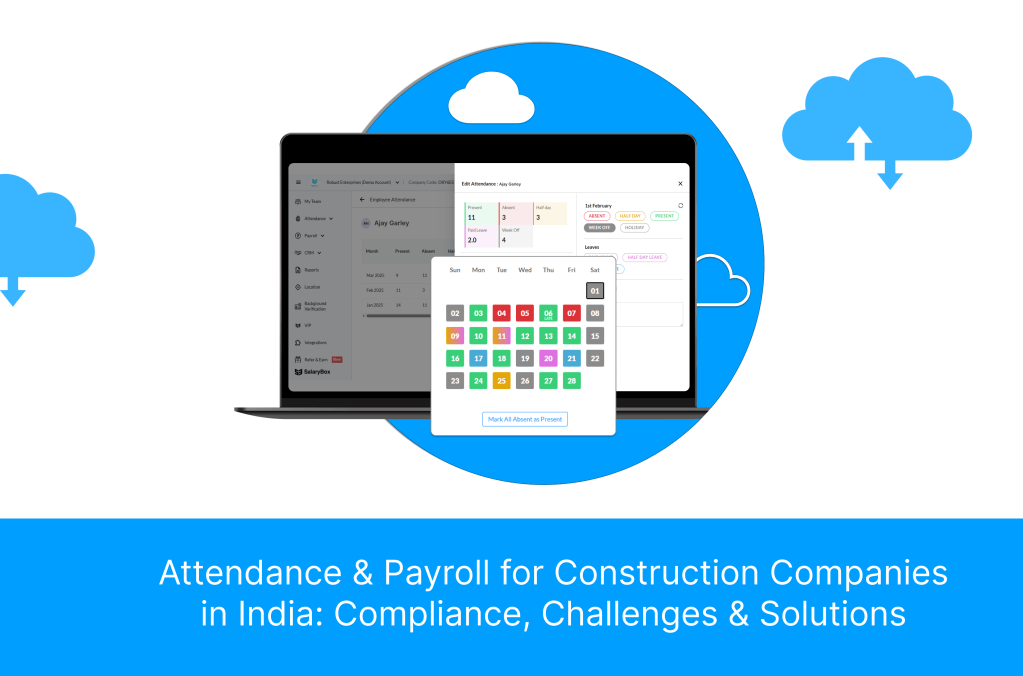
Construction companies in India must manage payroll, attendance, and compliance for site workers by implementing a structured system that accounts for the sector’s unique complexity. With over 70 million workers across thousands of sites, construction payroll requires tracking daily wages, overtime, advances, and deductions for workers who may be employed directly or through contractors. Attendance must be captured at remote, multi-entry construction sites where workers may lack literacy, where internet connectivity is unreliable, and where weather disruptions frequently alter schedules.
To stay compliant, construction companies must register under the Building and Other Construction Workers (BOCW) Act for 10 or more workers, pay the mandatory 1% cess on construction cost, maintain site-based muster rolls and wage registers available for inspection, and ensure PF/ESI contributions for eligible workers. The Code on Social Security 2020, effective from November 2025, subsumes the BOCW Act and introduces self-assessment cess mechanisms. Principal employers are jointly liable for contractor compliance failures, making oversight of contractor payroll essential.
The most effective approach is a mobile-first payroll and attendance app with GPS geofencing and offline capability. SalaryBox provides exactly this: GPS-verified selfie attendance that works without internet, automatic muster roll generation, daily/weekly/monthly wage calculation, and compliance-ready reports for PF, ESI, and BOCW. This guide covers every aspect of construction payroll compliance, challenges, and digital solutions for 2026.
Key Takeaway
Construction payroll in India involves 70M+ workers, multiple labour laws (BOCW Act, EPF, ESI, Contract Labour Act), and complex multi-site attendance tracking. Digital tools like SalaryBox with GPS geofencing and offline sync are now essential for compliance with the Code on Social Security 2020 requirements effective from late 2025.
Why Is Payroll & Attendance So Complex for Construction Companies?
India’s construction sector is the second-largest employer after agriculture, with over 70 million workers as of 2023 and projections reaching 100 million by 2030. The sector contributes approximately 9% to GDP and is growing at around 7% in FY 2025-26. Yet, an estimated 44 million of these workers remain in the informal economy, making up roughly 12-13% of India’s total workforce. This massive scale, combined with deep informality, creates payroll and attendance challenges unlike any other industry.
What Makes Construction Workforce Management Unique?
- Multi-Site Operations: A single construction company may operate 5-50 active sites simultaneously. Workers move between sites based on project needs, making centralized attendance tracking extremely difficult.
- Contractor Layers: Most construction work flows through 2-4 layers of contractors and sub-contractors. The principal employer bears joint liability for wage compliance even for workers they did not directly hire.
- Migrant Workforce: A significant portion of construction workers are inter-state migrants. They often lack local documentation, bank accounts, and permanent addresses, complicating KYC, PF enrollment, and wage disbursement.
- Variable Wage Cycles: Construction sites employ daily-wage labourers, weekly-paid helpers, and monthly-salaried supervisors simultaneously. Each category requires different calculation methods, payment schedules, and compliance treatment.
- Weather and Project Disruptions: Rain, material delays, and permit issues frequently halt work. Payroll must account for partial days, standby wages, and idle time across dozens of workers per site.
- High Informality: Cash payments, no written contracts, and missing records are common. Yet 24% of workplace deaths in India occur on construction sites, making documentation critical for accident claims and insurance.
- Literacy Challenges: Many construction labourers cannot read or write. Attendance systems requiring PIN entry or form-filling fail in practice. Biometric or photo-based systems are more effective.
- Infrastructure Gaps: Remote construction sites often lack reliable electricity and internet connectivity. Any digital attendance or payroll system must work offline and sync when connectivity returns.
What Are the Biggest Payroll & Attendance Challenges in Construction?
The following table summarises the ten most critical challenges that construction companies face when managing payroll and attendance, along with the impact and a recommended solution approach for each.
| # | Challenge | Impact | Solution Approach |
| 1 | Multi-site attendance tracking | Workers split across sites; no single source of truth for who worked where and when | GPS geofenced attendance per site with automatic site tagging |
| 2 | Daily-wage vs monthly-wage workers | Different calculation logic, payment cycles, and compliance requirements coexist | Flexible payroll engine supporting daily, weekly, and monthly cycles |
| 3 | Contractor vs direct-hire payroll | Principal employer liable for contractor non-compliance; dual record-keeping needed | Unified platform with contractor-wise worker grouping and compliance tracking |
| 4 | Migrant worker documentation | Missing Aadhaar, bank accounts, or local addresses delay PF/ESI enrollment | Digital onboarding with document upload and progressive KYC completion |
| 5 | Overtime calculation across sites | Workers may do regular hours at Site A, overtime at Site B on the same day | Consolidated attendance dashboard aggregating hours across all sites per worker |
| 6 | BOCW cess compliance | 1% cess on construction cost must be deposited; failure blocks project approvals | Automated cess calculation linked to project budgets and billing milestones |
| 7 | Muster roll maintenance | Form-XIV muster rolls must be site-based and available for inspector visits at any time | Auto-generated digital muster rolls from daily attendance data, printable on demand |
| 8 | Advance and loan deductions | Workers frequently take daily or weekly advances; manual tracking leads to disputes | In-app advance ledger with worker acknowledgment and automatic payroll deduction |
| 9 | Seasonal workforce fluctuations | Headcount may swing from 50 to 500 workers based on project phase | Scalable system with no per-worker licensing caps and quick onboarding |
| 10 | Safety compliance linked to payroll | Accident insurance, BOCW benefits, and compensation depend on accurate attendance and wage records | Integrated attendance-payroll data feeding into compliance and insurance reports |
What Labour Laws Apply to Construction Companies in India?
Construction companies in India must comply with a complex web of central and state labour laws. The four Labour Codes (Wages, Social Security, Industrial Relations, and OSH) passed between 2019-2020 are consolidating 29 older laws, with the Code on Social Security 2020 subsuming the BOCW Act from November 2025. Until full implementation, companies must comply with both legacy Acts and new Code provisions where notified. Here is a comprehensive compliance matrix.
| Law / Code | Applicability Threshold | Key Requirement for Construction | Penalty for Non-Compliance |
| BOCW Act 1996 / Code on Social Security 2020 | 10+ construction workers | Register establishment; pay 1% cess on construction cost (excluding land); register workers for welfare benefits | Up to Rs 2 lakh fine and/or imprisonment up to 3 months |
| OSH Code 2020 (replaces BOCW safety provisions) | 10+ workers (with threshold site value) | Safety standards, welfare facilities, working hours, annual health checks, accident reporting | Up to Rs 3 lakh fine; Rs 5 lakh and 6 months imprisonment for fatal accidents |
| Contract Labour Act 1970 / IR Code 2020 | 20+ contract workers | Obtain contractor license; principal employer maintains records; ensure equal wages for equal work | Up to Rs 1 lakh fine and/or imprisonment up to 3 months |
| EPF Act 1952 / Code on Social Security 2020 | 20+ employees (voluntary for smaller) | 12% employer + 12% employee PF contribution for wages up to Rs 15,000/month; file ECR monthly | 12% annual interest on delayed deposits; criminal prosecution for defaults |
| ESI Act 1948 / Code on Social Security 2020 | 10+ employees; wages up to Rs 21,000/month | 3.25% employer + 0.75% employee ESI contribution; medical benefits for workers and families | Up to Rs 5,000 fine per default period |
| Payment of Wages Act / Code on Wages 2019 | All establishments | Pay wages before 7th of each month; limited deductions; wages in bank account or digital mode | Up to Rs 50,000 fine; Rs 1 lakh for repeat offences |
| Minimum Wages Act / Code on Wages 2019 | All establishments | Pay at least state-notified minimum wages for construction category; revise with VDA biannually | Up to Rs 50,000 fine per worker per instance |
| Inter-State Migrant Workers (Code on Social Security 2020) | 5+ inter-state migrants | Register migrant workers; provide displacement allowance, journey allowance, and suitable accommodation | Up to Rs 1 lakh fine |
| Maternity Benefit Act 1961 / Code on Social Security 2020 | 10+ employees | 26 weeks paid maternity leave; no termination during pregnancy; creche for 50+ employees | Up to Rs 50,000 fine and/or imprisonment up to 3 months |
| Equal Remuneration Act / Code on Wages 2019 | All establishments | Equal wages for men and women performing same or similar work; no gender discrimination in hiring | Up to Rs 20,000 fine; Rs 50,000 for repeat offences |
| Payment of Gratuity Act 1972 | 10+ employees | 15 days wages per year of service for workers completing 5 continuous years | Up to Rs 20,000 fine and/or imprisonment up to 1 year |
| Employees Compensation Act 1923 | All establishments | Compensation for work injuries, occupational diseases, and death during employment | 50% penalty surcharge on delayed payments; imprisonment for wilful default |
Construction companies should note that the Code on Social Security 2020 introduces a unified social security framework. The transition from legacy Acts to the new Codes requires updating registration, returns filing, and record-keeping practices. Companies operating across states must also comply with respective state-level rules and minimum wage notifications.
2026 Labour Code Update: The four new Labour Codes — particularly the Code on Wages and the Code on Social Security — are being implemented state by state and directly impact construction companies. Key changes include a revised definition of “wages” (capping allowances at 50% of total remuneration, increasing PF/ESI base), standardised overtime at 2x the ordinary wage rate, and expanded social security coverage for gig and contract workers. Construction firms should ensure their payroll systems can adapt to these updated calculation rules as each state notifies them.
What Is the BOCW Act and How Does Construction Cess Work?
The Building and Other Construction Workers (Regulation of Employment and Conditions of Service) Act, 1996 (BOCW Act) is the primary legislation governing construction worker welfare in India. It is complemented by the BOCW Cess Act, 1996, which mandates the collection of cess to fund worker welfare.
How Is the BOCW Cess Calculated?
- Cess Rate: 1% of the total construction cost, excluding the cost of land. For a Rs 10 crore project (with Rs 2 crore land cost), the cess would be Rs 8 lakh (1% of Rs 8 crore).
- Who Pays: The employer or project owner bears the cess. It is collected by the local authority or cess-collecting body before granting building permits or approvals.
- Self-Assessment: Under the Code on Social Security 2020, employers will self-assess and remit cess rather than having it collected at permit stage, making timely compliance even more critical.
- Registration Threshold: Mandatory for establishments employing 10 or more construction workers on any day in the preceding 12 months.
What Benefits Do Workers Get Under BOCW?
- Pension: Monthly pension for registered construction workers after age 60.
- Maternity Benefit: Lump-sum maternity assistance for female construction workers.
- Education Scholarships: Financial support for children of registered workers from Class 1 through professional education.
- Housing Assistance: Subsidised loans or grants for housing construction.
- Accident Insurance: Compensation for death or permanent disability occurring during work. Given that 24% of workplace deaths in India occur on construction sites, this benefit is critical.
- Funeral Assistance: Financial support to the family of a deceased worker.
- Skill Upgradation: Training programs to help workers acquire new construction skills.
To access these benefits, workers must be registered with the State BOCW Welfare Board and hold a valid beneficiary card. Construction companies play a key role by facilitating worker registration and ensuring cess payments are up to date.
How to Track Attendance on Construction Sites?
Attendance tracking on construction sites presents unique challenges that office-based systems cannot address. Sites are spread across cities, workers enter from multiple access points, electricity and internet may be absent, and many workers cannot operate digital interfaces. Choosing the right attendance method directly impacts payroll accuracy, compliance, and operational efficiency.
What Are the Key Challenges of Construction Site Attendance?
- Remote Locations: Sites in rural or peri-urban areas with no stable internet or power supply.
- Multiple Entry Points: Large sites have 2-5 entry gates. Workers may enter from different points on different days.
- Literacy Barriers: Workers who cannot read or write cannot use PIN-based or form-based systems effectively.
- Harsh Conditions: Dust, rain, extreme heat, and mud damage biometric devices and paper records.
- High Turnover: Workers join and leave frequently; enrollment in complex systems wastes time.
How Do Different Attendance Methods Compare for Construction?
| Feature | Paper Muster Roll | Biometric Device | Mobile App with GPS (e.g., SalaryBox) |
| Accuracy | Low – prone to proxy entries and errors | High – fingerprint verification | High – GPS + selfie verification eliminates proxy |
| Setup Cost | Negligible (register book) | Rs 8,000-25,000 per device per site | Rs 0 – uses existing smartphones |
| Multi-Site Support | Separate registers; no consolidation | Separate devices; manual data collection | Single dashboard for all sites with geofencing |
| Offline Capability | Works offline by default | Requires power; data stored locally | Full offline mode; auto-syncs when online |
| Compliance Readiness | Manual Form-XIV preparation | Data export needed; manual formatting | Auto-generates Form-XIV muster rolls |
| Fraud Prevention | Very low – easy to manipulate | Moderate – buddy punching via shared fingerprints rare | High – GPS proves location; selfie proves identity |
| Worker Friendliness | Familiar but time-consuming | Fingerprint issues with dust/cuts on hands | Simple selfie; no literacy required |
| Weather Resistance | Paper damaged in rain | Devices malfunction in dust/heat | Phone-based; protected by worker |
| Real-Time Visibility | None – data available after manual entry | Delayed – requires data download | Instant – live dashboard and alerts |
| Scalability | Unmanageable beyond 50 workers per site | One device per 100-150 workers | Unlimited workers; one phone per supervisor |
For construction companies managing multiple sites with varying connectivity, a mobile app with GPS geofencing and offline sync offers the best combination of accuracy, compliance readiness, and cost-effectiveness. SalaryBox is specifically designed for this use case, allowing supervisors to mark GPS-verified selfie attendance even in areas with no internet connectivity, with data syncing automatically once the device is back online.
How Should Construction Companies Structure Worker Payroll?
Construction sites employ workers across vastly different roles, skill levels, and payment structures. A well-structured payroll system must accommodate these variations while ensuring minimum wage compliance and accurate deductions. Here is a breakdown of common worker categories and their payroll parameters.
What Are the Typical Worker Categories and Wage Structures?
| Worker Category | Typical Daily Wage (2026) | Monthly Equivalent (26 days) | Payment Cycle | Compliance Responsibility |
| Unskilled Labourer (Helper) | Rs 500-800 | Rs 13,000-20,800 | Daily or Weekly | Contractor (principal employer jointly liable) |
| Semi-Skilled (Mason Helper, Bar Bender) | Rs 700-1,000 | Rs 18,200-26,000 | Weekly | Contractor |
| Skilled Worker (Mason, Carpenter, Plumber) | Rs 900-1,500 | Rs 23,400-39,000 | Weekly or Monthly | Contractor or Direct Employer |
| Highly Skilled (Electrician, Welder, Crane Operator) | Rs 1,200-2,000 | Rs 31,200-52,000 | Monthly | Usually Direct Employer |
| Site Supervisor / Foreman | Rs 1,500-2,500 | Rs 39,000-65,000 | Monthly | Direct Employer |
| Machine Operator (JCB, Excavator) | Rs 1,000-1,800 | Rs 26,000-46,800 | Monthly | Direct Employer or Equipment Contractor |
| Contract Worker (via Sub-Contractor) | Rs 500-1,200 | Rs 13,000-31,200 | As per contractor terms | Sub-Contractor (all layers jointly liable) |
Note: Wage ranges are indicative and vary significantly by state, city, and specific skill. Always refer to the latest state minimum wage notification for the construction sector. Minimum wages for construction workers in India in 2026 range from Rs 400-600/day for unskilled work to Rs 700-1,200/day for skilled work depending on the state.
How Is Payroll Calculated for a Daily-Wage Construction Worker?
Here is a sample calculation for a daily-wage mason working on a construction site:
- Daily Wage: Rs 1,000 (state minimum for skilled construction worker)
- Days Worked: 24 regular days in the month
- Overtime Days: 3 days (worked on weekly off days at double rate as per law)
- Gross Earnings: (24 x Rs 1,000) + (3 x Rs 2,000) = Rs 24,000 + Rs 6,000 = Rs 30,000
- PF Deduction (12%): Rs 1,800 (on basic up to Rs 15,000)
- ESI Deduction (0.75%): Rs 225 (if wages under Rs 21,000/month – not applicable here as gross exceeds threshold)
- Advance Recovery: Rs 2,000 (advance taken during the month)
- Net Payable: Rs 30,000 – Rs 1,800 – Rs 2,000 = Rs 26,200
This calculation must be done for each worker category, adjusted for the specific state minimum wage, and documented in the wage register. When multiplied across hundreds of workers on multiple sites, the complexity is clear.
What Records Must Construction Companies Maintain?
Indian labour law mandates that construction companies maintain specific registers and records at each construction site. These must be available for inspection by labour inspectors at any time during working hours. Failure to maintain proper records can result in penalties and prosecution.
| Register / Record | Prescribed Format | Key Contents | Retention Period | Inspection Authority |
| Muster Roll | Form-XIV (BOCW Rules) | Daily attendance with in/out time, site location, work description for each worker | 3 years after last entry | Labour Inspector / BOCW Inspector |
| Wage Register | Form-XVII (BOCW Rules) | Gross wages, deductions (PF, ESI, advances, fines), net pay, payment mode and date | 3 years after last entry | Labour Inspector |
| Overtime Register | Form-X | Overtime hours, rate, amount for each worker per day; reason for overtime | 3 years | Labour Inspector |
| Deduction Register | Form-XX | All deductions from wages with worker consent; advance ledger, loan recovery schedule | 3 years | Labour Inspector |
| BOCW Worker Register | Form-VI | Worker personal details, skill category, nominee, date of registration, photo, Aadhaar | Until worker de-registration | BOCW Inspector / Welfare Board |
| Contractor License Register | Form-XII (Contract Labour Rules) | Contractor details, license number, validity, number of workers, nature of work | Duration of contract + 3 years | Labour Inspector |
| Accident Register | Form-XVIII | Date, time, location, nature of accident, worker details, treatment, lost days, compensation | 5 years after the last entry | Factory Inspector / OSH Inspector |
| Employment Card | Form-III (BOCW Rules) | Issued to each worker with employer details, wage rate, dates of employment | Duration of employment | Worker retains; copy with employer |
Paper muster rolls and registers are increasingly inadequate for meeting 2026 compliance requirements. Inspectors expect organised, legible records that can be produced quickly. Digital records that can be printed on demand offer a significant compliance advantage while reducing the administrative burden on site supervisors.
How Does Manual vs Digital Payroll Compare for Construction?
Construction companies typically evolve through three stages of payroll management: paper-based manual systems, Excel spreadsheets, and dedicated payroll applications. Each approach has distinct strengths and limitations. The following comparison helps you evaluate where your company stands and what an upgrade would deliver.
| Feature | Manual / Paper | Excel Spreadsheets | Payroll App (e.g., SalaryBox) |
| Multi-Site Tracking | Separate registers per site; no consolidation | Separate files or complex linked sheets | Single dashboard with site-wise filtering |
| Muster Roll Generation | Handwritten Form-XIV; error-prone | Template-based; manual data entry | Auto-generated from attendance data; print-ready |
| Overtime Calculation | Manual counting; frequent errors | Formula-based but requires manual input | Automatic from attendance clock-in/out times |
| Contractor Management | Separate records; hard to reconcile | Separate worksheets; no access control | Contractor-wise grouping with segregated access |
| Compliance Reports (PF/ESI/BOCW) | Manually compiled; delays common | Partially automated; format issues | One-click generation in prescribed formats |
| Audit Readiness | Very low; records often incomplete | Moderate; depends on discipline | High; complete trail with timestamps |
| Setup Cost | Near zero | Near zero (if Excel already available) | Free to low-cost (SalaryBox free tier available) |
| Monthly Time Investment | 40-60 hours per 100 workers | 20-30 hours per 100 workers | 3-5 hours per 100 workers |
| Error Rate | High (15-25% discrepancies) | Moderate (5-10%) | Very Low (less than 1%) |
| Scalability | Breaks down beyond 2-3 sites | Becomes unmanageable at 5+ sites | Handles unlimited sites and workers |
| Worker Self-Service | None | None | Workers can view pay slips and attendance on phone |
| Advance & Loan Tracking | Notebook-based; disputes common | Spreadsheet ledger; no worker visibility | In-app ledger with worker acknowledgment |
The comparison makes clear that paper-based systems are no longer viable for construction companies managing more than one site or 50 workers. Excel provides an intermediate solution but cannot keep pace with real-time multi-site requirements. A purpose-built payroll app delivers the accuracy, speed, and compliance readiness that modern construction operations demand.
How Can SalaryBox Help Construction Companies?
SalaryBox is designed specifically for Indian businesses managing distributed, blue-collar, and mixed workforces, making it particularly well-suited for construction companies. Here is how it addresses the specific challenges outlined in this guide.
What Features Does SalaryBox Offer for Construction?
- GPS Geofencing Per Site: Set a virtual boundary around each construction site. Attendance is only recorded when the worker is physically within the geofenced area, eliminating location fraud. Each site operates as an independent geofenced zone on a single dashboard.
- Offline Attendance Sync: SalaryBox works fully offline. Supervisors can mark attendance using GPS and selfie verification even at remote sites with no internet. Data syncs automatically to the cloud when the phone connects to WiFi or mobile data.
- Daily, Weekly & Monthly Wage Support: Configure different pay cycles for different worker categories. Daily-wage labourers, weekly-paid helpers, and monthly-salaried supervisors can all be managed in the same system with category-specific calculation rules.
- Contractor Worker Tracking: Group workers by contractor. Track contractor-wise attendance, wages, and compliance separately while maintaining a consolidated view for the principal employer. This directly addresses the joint liability requirement under the Contract Labour Act.
- Auto Muster Roll Generation: Generate Form-XIV compliant muster rolls automatically from daily attendance records. Print or share digitally for inspector visits. No more handwritten registers or last-minute compilation.
- PF & ESI Compliance: Automatic PF and ESI calculation based on eligible wages. Generate ECR files for EPFO submission. Track contribution history per worker across months and sites.
- Advance & Loan Management: Record advances and loans with worker acknowledgment in the app. Set up automatic deduction schedules from future wages. Workers can see their advance balance on their own phones, reducing disputes.
- Multi-Site Dashboard: View real-time attendance, headcount, and payroll summaries across all construction sites from a single screen. Drill down into any site for detailed worker-level data.
SalaryBox offers a free plan for small construction businesses and affordable paid plans for larger operations. The app is available in Hindi and multiple Indian languages, which is essential for construction workforce adoption.
Frequently Asked Questions About Construction Payroll & Attendance in India
Q: How to manage payroll for construction workers in India?
A: Use a mobile-first payroll app like SalaryBox that supports daily, weekly, and monthly wage cycles. Track attendance with GPS geofencing per site, calculate wages automatically based on attendance records, deduct PF/ESI/advances, and generate compliant pay slips. For contractor workers, maintain separate records while ensuring the principal employer meets joint liability obligations under the Contract Labour Act.
Q: What is the BOCW cess registration process?
A: Employers with 10 or more construction workers must register with the State BOCW Welfare Board. File Form-I (application for registration) along with proof of business, project details, and estimated construction cost. Pay the 1% cess on total construction cost (excluding land value) to the cess-collecting authority. Under the Code on Social Security 2020 (effective November 2025), this shifts to a self-assessment model. Registration must be renewed periodically as per state rules.
Q: What are construction worker minimum wages in India in 2026?
A: Minimum wages for construction workers vary by state and skill level. As of 2026, unskilled construction labourers earn Rs 400-600 per day depending on the state, semi-skilled workers earn Rs 600-900, skilled workers (masons, carpenters, plumbers) earn Rs 800-1,200, and highly skilled workers earn Rs 1,000-1,800. Delhi, Mumbai, and Bangalore typically have the highest rates. Always check the latest state minimum wage notification for the construction sector as rates are revised biannually with Variable Dearness Allowance (VDA) adjustments.
Q: Is attendance tracking mandatory for construction sites in India?
A: Yes. Under the BOCW Act and rules, employers must maintain a muster roll (Form-XIV) at each construction site recording daily attendance with in-time and out-time for every worker. This register must be available for inspection by labour inspectors at any time during working hours. The OSH Code 2020 reinforces this requirement. Failure to maintain attendance records can result in fines up to Rs 2 lakh and prosecution.
Q: What happens if a construction company does not comply with the BOCW Act?
A: Non-compliance with the BOCW Act carries penalties including fines up to Rs 2 lakh and imprisonment up to 3 months for the employer or responsible person. Additionally, failure to pay cess can block project approvals, building permits, and completion certificates. Under the Code on Social Security 2020, penalties are significantly enhanced, and repeat offences attract higher fines. Labour inspectors can issue stop-work orders for serious safety violations.
Q: How should construction companies handle payroll for migrant workers?
A: Migrant workers from other states must be registered under the Inter-State Migrant Workers provisions (now part of the Code on Social Security 2020). Employers must provide displacement allowance (50% of monthly wages, one-time), journey allowance for travel to and from the home state, and suitable accommodation. Payroll should be disbursed in bank accounts (employers should assist in account opening). Maintain records of home state, native address, and family details. Facilitate PF and ESI enrollment using available documents.
Q: Can construction companies use biometric attendance on sites?
A: Yes, but biometric attendance has practical limitations on construction sites. Fingerprint scanners malfunction in dusty, wet conditions, and workers with calloused or cut hands face frequent scan failures. Face recognition requires adequate lighting. Devices need power supply and periodic maintenance. A more practical alternative is mobile app-based attendance using GPS geofencing and selfie verification, which works on any smartphone, requires no additional hardware, operates offline, and proves both identity and location.
Q: What is the penalty for not maintaining a muster roll on a construction site?
A: Under the BOCW Rules, failure to maintain the prescribed muster roll (Form-XIV) at a construction site can result in a fine up to Rs 2 lakh for the first offence and enhanced penalties for repeat violations. Labour inspectors conducting site visits will check muster rolls as a primary compliance document. Absence or incompleteness of the muster roll can trigger detailed audits of wage payments, PF/ESI compliance, and worker registration. Digital muster rolls generated from attendance apps are accepted by most state labour departments.
Ready to Simplify Construction Payroll & Attendance?
SalaryBox provides GPS-verified attendance, offline sync, automatic muster roll generation, and complete payroll processing designed for India’s construction sector. Download free from Google Play or visit salarybox.in to get started.
Disclaimer: This article is for informational purposes only and does not constitute legal or financial advice. Labour laws and minimum wages vary by state and are subject to periodic revision. Construction companies should consult qualified legal professionals for compliance guidance specific to their state and project type. Wage figures mentioned are indicative ranges based on 2025-2026 notifications and may have been revised.
