
AI Selfie Attendance vs Biometric Machines: Which Is Better for Indian Businesses in 2026?
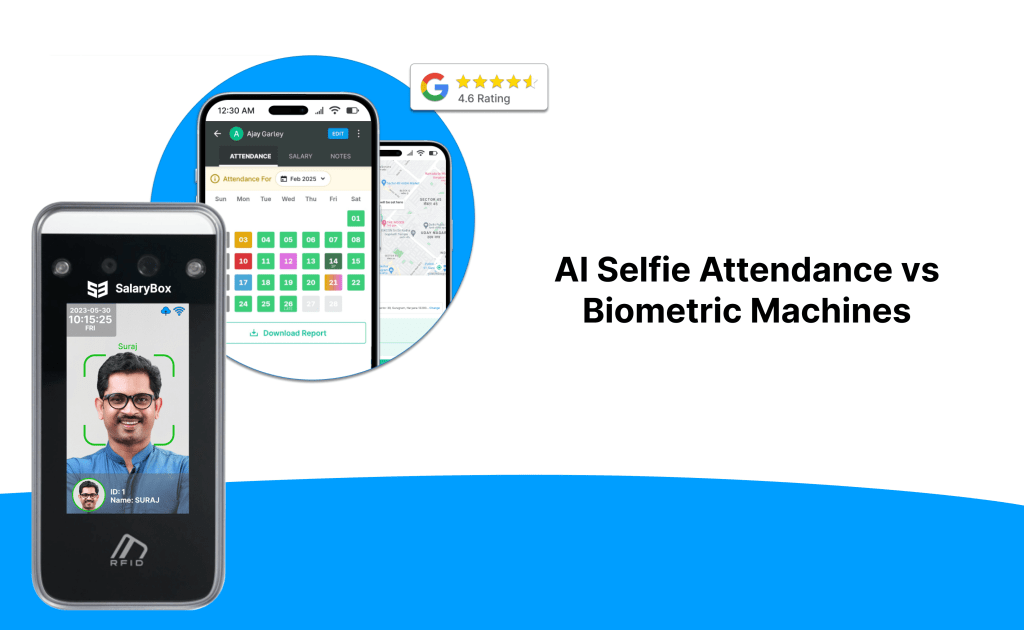
Introduction: The Attendance Dilemma for Indian Businesses in 2026
In 2026, Indian businesses face rising costs, stricter payroll compliance in India, and a hybrid workforce that includes office staff, field teams, and remote employees. Accurate attendance tracking directly impacts payroll processing in India, statutory deductions like PF, ESI, and TDS, and overall operational efficiency.
Traditional biometric machines have long been the standard, but AI selfie attendance systems are rapidly gaining traction—especially among SMEs, startups, and companies with distributed teams. Governments like Karnataka are already shifting to AI and GIS-enabled selfie systems for cost-effectiveness and flexibility.
This detailed comparison explores AI selfie attendance vs biometric machines for Indian businesses. It covers features, costs, pros/cons, real-world suitability, payroll integration, and future trends to help you decide what works best for your operations in 2026.
Understanding Biometric Attendance Machines
Biometric machines primarily use fingerprint, face recognition, or iris scanning. Employees physically interact with a hardware device at entry/exit points.
Key Features (2026):
- High accuracy with fingerprint or advanced face recognition.
- Standalone or cloud-connected models.
- Often includes RFID card support.
- Generates logs for shift calculations.
Common Use Cases: Factories, large offices, manufacturing units with fixed entry points.
Limitations in Indian Context:
- High initial hardware investment (₹8,000–₹25,000+ per device).
- Maintenance, power issues, and wear-and-tear in dusty or humid environments.
- Not ideal for field staff, sales teams, or multi-location businesses.
- Proxy attendance risks if not combined with advanced anti-spoofing.
- Queues during peak hours reduce productivity.
AI Selfie Attendance: The Modern Mobile Alternative
AI selfie attendance lets employees mark presence via a smartphone app by taking a quick selfie. AI verifies the face in real-time, often combined with GPS/geofencing for location accuracy.
How It Works (Example with Advanced Platforms):
- Employee opens the app, captures a selfie.
- AI matches it against enrolled photo with liveness detection (anti-spoofing).
- GPS confirms location; timestamp is recorded.
- Data flows instantly to a cloud dashboard.
This method supports field staff, hybrid teams, and distributed workforces common in India.
Head-to-Head Comparison: AI Selfie vs Biometric Machines
1. Cost Breakdown (2026 India Estimates)
- Biometric Machines: High upfront cost. Multiple devices for large offices can run into lakhs. Add installation, annual maintenance (₹2,000–5,000 per device), replacements every 4-5 years, and software subscriptions. Hidden costs include downtime and repairs.
- AI Selfie Attendance: Minimal to zero hardware cost. Uses employees’ existing smartphones. Subscription-based (often affordable per user/month for SMEs). Scalable without extra capital expenditure—ideal for growing teams or startups.
Winner for Cost: AI selfie systems offer significantly lower total cost of ownership, especially for small and medium businesses.
2. Accuracy and Security
Both can achieve high accuracy, but:
- Biometrics: Strong when hardware is well-maintained, but fingerprint scanners fail with dirty/wet hands, injuries, or aging.
- AI Selfie: Advanced liveness detection prevents photos or deepfakes. Combined with GPS, it verifies both “who” and “where.”
Proxy attendance is harder with verified selfies + location.
3. Convenience and Scalability
- Biometric: Requires physical presence at devices. Challenging for field sales, service technicians, or multi-branch setups.
- AI Selfie: Employees mark attendance from anywhere within geofenced areas. Perfect for “best attendance system for field staff India.”
No queues, works on low-end phones, and supports real-time tracking.
4. Hygiene and Post-Pandemic Relevance
AI selfie is fully contactless, aligning with ongoing health preferences in 2026.
5. Maintenance and Reliability
Biometric devices need regular cleaning, updates, and face power/network issues. Mobile apps update seamlessly via cloud with minimal downtime.
6. Payroll Integration and Compliance
Accurate attendance is foundational for Indian payroll, statutory deductions in India payroll (PF, ESI, TDS), and payroll compliance in India.
- Errors in attendance lead to wrong gross vs net salary, incorrect overtime, leave balances, and Form 16 issues.
- Seamless integration automates monthly payroll cycle India, reduces manual errors, and ensures timely PF ESI TDS filing.
- Platforms with built-in compliance handle Code on Wages 2019, minimum wages, and multi-state requirements.
AI selfie systems that feed directly into payroll software minimize discrepancies and support automated payslip generation, reports, and audits.
Suitability for Different Indian Business Types
- Manufacturing/Factories: Biometric still viable for controlled entry points, but hybrid (biometric + mobile for supervisors) is emerging.
- SMEs, Startups, Retail, Services: AI selfie shines—low cost, easy scaling, mobile-first.
- Field Staff & Distributed Teams: Mobile attendance app with GPS + selfie is essential. Traditional machines are impractical.
- Multi-State Operations: Cloud-based systems handle varying compliance needs better.
For most growing Indian businesses in 2026, AI-powered mobile solutions provide better ROI.
How Attendance Impacts Payroll Processing in India
Payroll processing steps in India start with accurate attendance data:
- Capture worked hours, overtime, leaves.
- Calculate basic salary structure, HRA, other allowances.
- Apply statutory deductions: Provident Fund PF contribution, ESI contribution rates, Professional Tax PT slabs, TDS.
- Generate payslips, ensure salary disbursement.
- File returns (Form 24Q etc.) and issue Form 16.
Manual or error-prone attendance leads to payroll errors and penalties in India—late PF deposits, TDS issues, or non-compliance fines. Automated systems with direct integration reduce processing time, improve accuracy, and support cloud payroll system India best practices.
Businesses benefit from payroll software India or services that bundle attendance, ensuring end-to-end automation for employee payroll processing India.
Real-World Benefits and Trends in 2026
- Time Savings: HR teams spend less on reconciliation.
- Employee Experience: Self-service portals for attendance, leaves, and payslips boost satisfaction.
- Analytics: Insights into absenteeism, productivity for better decisions.
- Future-Proofing: AI advancements make selfie systems smarter with better fraud detection and integration.
Government adoption (e.g., Karnataka’s shift) signals broader acceptance of AI selfie solutions.
Why Integrated Platforms Like SalaryBox Stand Out
Modern platforms combine flexible attendance (selfie, GPS, biometric options) with full payroll management India. This creates a unified system for attendance, leave, compliance, and salary processing—reducing reliance on multiple tools.
For Indian SMEs seeking affordable, compliant solutions with strong mobile capabilities, such all-in-one tools minimize administrative burden while supporting growth. Features like automated deductions, digital payslips, and compliance updates make them practical for payroll outsourcing alternatives or in-house automation.
Conclusion: The Better Choice for Most Indian Businesses in 2026
AI selfie attendance emerges as the superior option for the majority of Indian businesses—particularly SMEs, service-oriented companies, and those with field or hybrid teams. It offers lower costs, greater flexibility, better scalability, and seamless payroll integration without the hardware headaches of traditional biometrics.
Biometric machines suit very specific high-security, fixed-location environments, but even there, hybrid approaches are gaining ground. As we move through 2026, embracing mobile-first, AI-driven solutions positions businesses for efficiency, compliance, and competitiveness.
Ready to modernize? Explore platforms that deliver AI selfie attendance with robust payroll tools tailored for Indian statutory requirements.
FAQs
Q1: Is AI selfie attendance as accurate as biometric machines for Indian companies?
Yes. Advanced AI systems use liveness detection and GPS to match or exceed biometric accuracy while preventing proxy issues more effectively. They integrate directly with payroll for error-free processing.
Q2: Which is more cost-effective for SMEs in India in 2026, selfie attendance or biometric?
AI selfie attendance is far more cost-effective. No expensive hardware, lower maintenance, and scalable subscriptions make it ideal for small businesses and growing teams, freeing up capital for other priorities.
Q3: How does attendance system choice affect payroll compliance in India?
Accurate, automated attendance ensures correct calculation of worked days, overtime, and deductions (PF, ESI, TDS). Integrated solutions reduce errors, support timely filings, and help avoid penalties, critical for payroll compliance in India.
Q4: Can field staff use AI selfie attendance effectively?
Absolutely. GPS + selfie verification allows field employees to mark attendance from client locations or on the move, making it one of the best options for distributed teams in India.
Q5: What makes SalaryBox a strong choice for attendance and payroll?
SalaryBox combines flexible AI selfie attendance with GPS, optional biometric support, and end-to-end payroll processing tailored for Indian compliance. It automates statutory requirements, generates reports, and provides self-service features—making it a practical, all-in-one solution for SMEs seeking efficiency without complexity.
Q6: Is it easy to switch from biometric to AI selfie system?
Yes, most modern platforms support data migration and hybrid modes during transition, minimizing disruption to your monthly payroll cycle.
